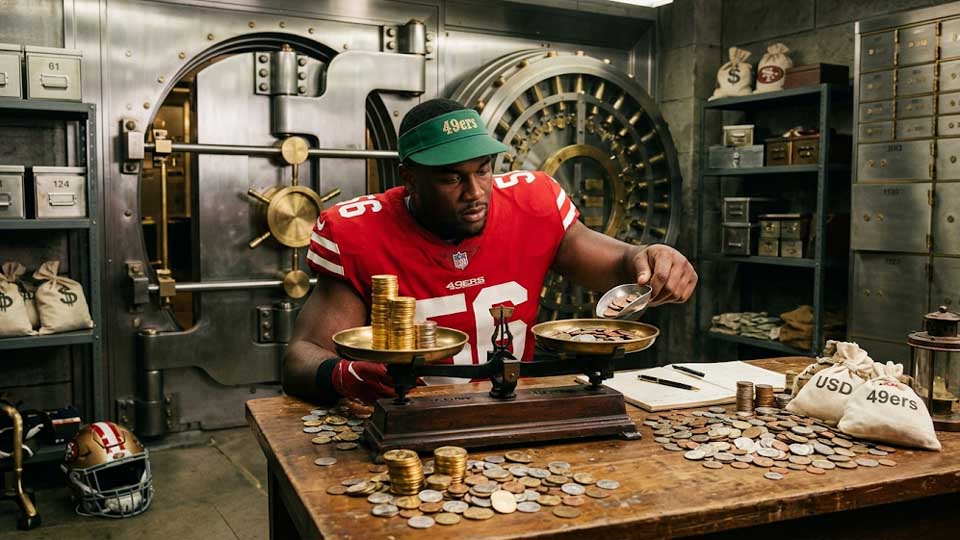
Using TriSync Sports to Build a More Dependable NFL DFS Lineup
Not every DFS lineup should be built the same way.
That's especially true when comparing:
CASH GAMES vs. GPP TOURNAMENTS
In a large GPP tournament, we're trying to beat thousands of lineups.
Finishing slightly above average doesn't accomplish much.
We need ceiling.
We need differentiation.
Sometimes we need to accept additional risk because we're trying to build a lineup capable of producing an exceptional score.
Cash games are different.
In contests such as:
50/50s
Double-Ups
and
Head-to-Heads
we don't need the highest-scoring lineup in the contest.
We simply need to:
Finish above the cash line.
That changes everything.
Instead of asking:
“Which players could explode?”
we're more interested in:
“Which players give us the strongest combination of expected production, opportunity, value and reliability?”
That's the foundation of the:
Balanced Cash Strategy
And TriSync Sports gives us several tools for identifying exactly those types of players.
What Does "Balanced" Mean?
Balanced doesn't mean every player has to cost approximately the same amount.
And it doesn't mean avoiding expensive players.
A Balanced Cash lineup can absolutely contain high-valued players.
What we're trying to avoid is creating a lineup where too many roster positions depend upon:
Uncertain roles
Low-probability touchdowns
Extreme ceiling performances
Boom-or-bust players
or
cheap selections who need everything to go right
We're looking for balance between:
Projection
Floor
Salary
Opportunity
and
Reliability
A strong cash lineup doesn't need nine spectacular performances.
It needs enough solid performances to get across the cash line.
The Goal Is Different
This is perhaps the most important concept in the entire article.
Imagine a 50/50 contest with 100 entries.
Approximately half of the field gets paid.
You don't need to finish:
1st
You need to finish:
50th or better.
Finishing first may pay exactly the same as finishing 40th.
That's very different from a GPP tournament.
In a tournament, moving from 50th to 1st could dramatically change the payout.
So why build both lineups the same way?
You shouldn't.
GPP Thinking vs. Cash Thinking
A tournament player might ask:
Who has the biggest ceiling?
Which lower-owned player could explode?
How can I create leverage against the field?
Which game could become a shootout?
Can I Double Stack this quarterback?
The cash player should be asking different questions:
Who has the strongest expected production?
Who has the most dependable opportunity?
Who gives me a strong floor for the salary?
Which TriSync signals have the most support?
Where can I find value without adding unnecessary risk?
That's the philosophical difference.
GPPs reward exceptional outcomes.
Cash games reward dependable decisions.
Start With the TriSync Projection
As with our other strategies, the:
remains one of our primary starting points.
The Projection helps answer:
What should we reasonably expect from this player today?
For cash games, we want to build a lineup filled with strong expected performances.
We're not necessarily looking for the highest Projection at every position.
Salary still matters.
Instead, we're looking for players whose Projections make sense relative to what we're paying.
That's where our next measurement becomes extremely important.
TriSync Value Projection Matters
A player can have an outstanding TriSync Projection and still be difficult to use.
Why?
Salary.
Suppose two running backs project closely.
RB A
TriSync Projection: 6.10
Salary: $8,600
RB B
TriSync Projection: 5.85
Salary: $6,700
RB A has the stronger raw Projection.
But RB B costs:
$1,900 less.
That difference may allow us to improve two other positions.
This is exactly why the:
becomes important.
It helps us identify players whose expected production creates attractive DFS value.
For cash games, we want as few weak roster positions as possible.
Value helps us accomplish that.
Floor Becomes More Important
Ceiling matters in every DFS contest.
But cash games put much more emphasis on:
FLOOR
The floor represents the lower end of what we reasonably expect from a player.
Think about the difference.
Player A might have:
Floor: 14
Ceiling: 24
Player B might have:
Floor: 7
Ceiling: 30
Which player is more exciting?
Probably Player B.
Which player might be more useful in a cash lineup?
Often:
Player A.
Why?
Because we aren't necessarily trying to capture the 30-point explosion.
We're trying to avoid the 7-point disappointment.
Cash Games Are About Avoiding Failure Too
DFS players naturally focus on:
Who can score the most?
But cash games require another question:
Who is least likely to hurt me?
One terrible roster position can create a major problem.
Two can destroy the lineup.
That's why a Balanced Cash lineup tries to reduce the number of fragile selections.
We're not eliminating risk.
That's impossible.
Football is unpredictable.
But we can choose not to introduce unnecessary risk.
The Aligned Profile Becomes Especially Useful
This is one area where TriSync Profile can become particularly valuable.
An:
Aligned
player has historically demonstrated a more consistent relationship between his performance-cycle conditions and actual results.
A:
Variable
player has historically been less predictable relative to those conditions.
Does that mean we automatically avoid Variable players in cash?
No.
An elite player with a tremendous Projection can still be an excellent cash selection.
But when we're comparing two relatively similar players?
The Aligned profile can become an important tiebreaker.
Suppose:
Player A
TriSync Projection: 5.80
Profile: Aligned
Salary: $6,200
Player B
TriSync Projection: 5.90
Profile: Variable
Salary: $6,300
The projections are extremely close.
In a tournament, we may have reasons to prefer Player B.
In cash?
Player A's Aligned profile may make him more attractive.
We're looking for dependability.
Use the Lower-Variance TriSync Perspective
When the TriSync DFS page provides different ways to examine expected performance ranges, cash players should generally lean toward the:
Lower-variance view.
Why?
Because we're asking:
What happens if everything DOESN'T go perfectly?
Tournament players are naturally interested in ceiling.
Cash players should be extremely interested in:
What remains when the ceiling doesn't arrive?
If a player still looks attractive under the more conservative TriSync view, that's meaningful.
He's not requiring an extreme performance to justify his salary.
That's exactly the type of player we want to find.
Opportunity Is King
TriSync shouldn't replace football information.
It should add another layer to it.
For cash games, opportunity is especially important.
At running back, look for:
Carries
Targets
Goal-line work
Snap share
and
a secure role
At wide receiver and tight end:
Targets
Routes
Red-zone opportunities
and
consistent involvement
At quarterback:
Passing volume
rushing involvement
offensive role
and
game environment
A great TriSync outlook combined with dependable football opportunity is exactly what we're searching for.
Running Back Can Be a Cash Foundation
Running backs with secure workloads can be extremely attractive in cash games.
Why?
Because opportunity creates multiple ways to score fantasy points.
A heavily involved RB can produce through:
Carries
Rushing yards
Receptions
Receiving yards
and
Touchdowns
A running back who also catches passes becomes particularly interesting.
He doesn't necessarily need to score a touchdown to produce a usable fantasy total.
That's important.
Touchdowns are valuable.
But they're also difficult to predict.
Volume can create a safer foundation.
Receiving Running Backs Deserve Extra Attention
This is especially true on DraftKings because receptions generate fantasy points.
Imagine two RBs.
RB A receives:
18 carries
and very little passing work.
RB B receives:
15 carries + 6 targets
Even before we consider yardage or touchdowns, RB B has additional paths toward producing fantasy points.
That's attractive in cash.
And if RB B also carries:
A strong TriSync Projection.
An Aligned profile.
A favorable TriSync Value Projection.
And a dependable floor.
Now we're checking several cash-game boxes at once.
Wide Receiver: Targets Matter
Wide receivers can be volatile.
One deep touchdown can create a huge score.
But that's not necessarily what we're searching for in cash.
Instead, look closely at:
TARGET VOLUME.
A receiver regularly seeing:
8
9
10
or more targets has repeated opportunities to generate fantasy production.
A receiver who gets only four targets may need one of them to become a long touchdown.
That's a much more fragile path.
When TriSync identifies a strong Projection for a receiver who also has dependable target volume?
That's an attractive cash combination.
Tight End: Don't Chase a Touchdown
Tight end can be frustrating.
Many TEs rely heavily on touchdowns to create strong fantasy scores.
For cash games, we'd rather find a tight end with:
Consistent targets
A stable role
A reasonable salary
and
A strong TriSync outlook
If he scores?
Great.
But we don't want the entire selection to depend on:
“Hopefully he catches a touchdown.”
That's tournament thinking.
For cash, look for opportunity first.
Quarterback: Reliability Before Heroics
At QB, we don't necessarily need the player with the highest ceiling on the slate.
We're looking for:
Strong TriSync Projection
Stable role
Reasonable floor
Passing volume
and ideally:
Rushing production
Rushing quarterbacks can be particularly useful because rushing yards create another scoring path.
If the passing touchdowns don't arrive, rushing production can help preserve the floor.
Again:
Multiple paths to points.
That's a recurring theme in cash construction.
Do We Stack in Cash?
We can.
But we don't have to.
That's an important difference from many tournament strategies.
If our preferred cash quarterback has a receiver who independently rates as one of our best plays?
Great.
Use:
QB + WR
or:
QB + TE
or:
QB + an RB averaging 5+ targets per game
The correlation becomes a bonus.
But don't force a stack.
If the best cash WRs come from completely different teams, that's perfectly fine.
The goal isn't:
Build a stack.
The goal is:
Build the most dependable lineup.
Avoid Forcing a Double Stack
The same principle applies even more strongly to Double Stacks.
A Double Stack concentrates three roster positions around one passing offense.
That's useful in tournaments when we're trying to capture an explosive performance.
But in cash?
Usually unnecessary.
If the offense disappoints, three positions can disappoint together.
We're trying to reduce unnecessary concentration.
There may be rare slates where three players from one offense independently qualify as excellent cash selections.
Fine.
But don't begin cash construction by deciding:
“I'm going to Double Stack.”
Let the individual players earn their positions.
Don't Force a Bring-Back Either
The Game Stack/Bring-Back Strategy is primarily about capturing a high-scoring game environment.
Again, that's excellent tournament thinking.
But a cash lineup doesn't require a game to turn into a shootout.
If your QB and WR are strong plays, use them.
You don't need to add an opposing WR merely because he's on the other side.
The Bring-Back needs to qualify as a strong individual cash selection.
If he does?
Use him.
If he doesn't?
Move on.
Lineup Signals Can Simplify the Process
TriSync's:
Lineup Signal
can help us quickly identify the role a player may have within a DFS lineup.
For cash, we're naturally interested in players carrying favorable designations such as:
Core
Premium
Value+
and
Value
But don't simply fill the lineup with one category.
A Balanced Cash lineup may contain:
A Premium player.
Several Core players.
Some Value+ selections.
And a Value player who provides needed salary relief.
The objective is balance.
Be Careful With Punt Plays
Cheap players are tempting.
They solve salary problems.
But cheap doesn't automatically mean value.
There's a big difference between:
Cheap
and
Underpriced.
An underpriced player may have:
A strong role.
A good Projection.
A favorable Value Projection.
And a low salary.
That's exactly what we want.
A cheap player with:
A weak role.
A low floor.
An unfavorable Projection.
And touchdown-dependent upside
isn't necessarily value.
He's simply inexpensive.
Cash lineups should avoid relying on too many players who need unusual outcomes to succeed.
Value+ Can Be a Cash Player's Best Friend
One of the most useful Lineup Signals for cash construction may be:
Value+
Why?
Because we're constantly trying to balance expected production against salary.
A strong Value+ option can provide enough salary relief to afford a Premium player elsewhere without sacrificing too much expected production.
Imagine saving:
$1,500
at WR
without dramatically reducing Projection.
Now that $1,500 upgrades:
A weak TE into a Core TE.
Or:
A mediocre RB2 into a high-volume RB.
That's how balanced lineups are built.
Premium Doesn't Mean Automatic
Expensive players can absolutely belong in cash.
But salary needs to earn its place.
Suppose a Premium RB costs:
$9,000
and carries an exceptional Projection and dependable workload.
He may be worth every dollar.
But if another RB costs:
$7,000
with a Projection only slightly lower?
We need to ask:
What can the extra $2,000 do elsewhere?
Cash construction is constantly about these tradeoffs.
Don't pay for the name.
Pay for the expected production.
Don't Chase Low Ownership
This is one of the biggest differences from GPP strategy.
In tournaments, low ownership can create leverage.
In cash?
We don't receive bonus points because nobody else selected our player.
If a highly popular player is:
Underpriced.
Projected strongly.
Receiving a huge workload.
And carrying a favorable TriSync outlook?
That's not necessarily a player we should fade.
Sometimes the crowd is right.
Cash games aren't about proving we're smarter than everyone with every selection.
They're about:
Beating the cash line.
Don't Be Afraid of Popular Plays
Suppose a starting RB is injured.
His backup now costs only:
$5,000
and is expected to receive:
18+ touches.
Everyone sees it.
His ownership could become enormous.
Does that make him a bad cash play?
Not necessarily.
If his:
TriSync Projection.
Value Projection.
Expected workload.
And floor
all support the selection, popularity may actually reduce the risk of fading him.
If he succeeds and most of the field owns him, you stay competitive.
If you fade him and he explodes, you've created a problem you didn't necessarily need.
That's very different from tournament strategy.
D/ST: Don't Overpay for Perfection
Defense/Special Teams can be volatile.
Turnovers.
Sacks.
Touchdowns.
Points allowed.
One play can dramatically change the score.
For cash games, don't automatically spend heavily chasing the highest-ceiling defense.
Look for a D/ST with:
A reasonable salary
A solid TriSync outlook
Sack opportunity
Turnover potential
and
an opponent that doesn't create excessive risk
The objective isn't necessarily to find the defense that scores 20.
We'd like to avoid the defense that scores:
Negative 2.
The TriSync Defense/Special Teams Projection is another important cash-game decision tool.
Balance Doesn't Mean Mediocrity
This is important.
We're not trying to create:
Nine average players.
We're trying to create:
Nine strong decisions.
A Balanced Cash lineup can still contain:
An elite quarterback.
A Core running back.
A star receiver.
What we want to avoid is paying so much for those players that the remaining roster spots become desperate.
The lineup should remain strong from top to bottom.
A Simple Balanced Cash Example
Imagine these hypothetical options.
RB A
Salary: $8,500
TriSync Projection: 6.30
Floor: 16
Profile: Aligned
Lineup Signal: Premium
RB B
Salary: $6,700
TriSync Projection: 5.95
Floor: 15
Profile: Aligned
Lineup Signal: Value+
RB C
Salary: $4,500
TriSync Projection: 4.40
Floor: 7
Profile: Variable
Lineup Signal: Filler
RB A is projected highest.
RB C is cheapest.
But RB B might be the most interesting cash selection.
Why?
We're sacrificing only:
0.35 in TriSync Projection
compared with RB A.
The floor is almost identical.
And we're saving:
$1,800.
Meanwhile, compared with RB C, we're paying more but gaining a much stronger expected performance and floor.
That's balance.
We're not automatically choosing:
The best player.
We're not automatically choosing:
The cheapest player.
We're searching for:
The best combination of production, floor and salary.
Build From the Middle Out
One way to approach the Balanced Cash Strategy is to avoid starting with either extreme.
Don't begin by stuffing the lineup with all the most expensive stars.
And don't begin by hunting for the cheapest possible plays.
Instead, identify the players who give you the strongest combination of:
TriSync Projection
Value Projection
Floor
Profile
Opportunity
and
Salary
Build the foundation.
Then determine where you can afford to spend up.
And where you can safely save.
Spend Up Where the Floor Comes With the Ceiling
If you're going to pay Premium salary in cash, ideally you're purchasing both:
FLOOR + CEILING.
An expensive player who needs a long touchdown to justify his salary isn't necessarily an ideal cash selection.
An expensive player receiving:
Heavy volume.
Red-zone opportunities.
Consistent targets.
And strong TriSync support
is different.
Now the salary is purchasing dependable opportunity along with upside.
That's much more attractive.
Save Where the Role Is Secure
Likewise, when saving salary, look for:
Secure opportunity at a discounted price.
Maybe an injury has moved a player into a larger role.
Maybe a WR2 is receiving significantly more targets than his salary suggests.
Maybe a TE has become a consistent part of the passing offense.
Maybe a running back's workload has increased.
Combine that information with TriSync.
If the player also carries:
A strong Projection.
A favorable Value Projection.
And a dependable profile?
Now we may have legitimate cash-game value.
Don't Confuse Safe With Guaranteed
There is no such thing as a guaranteed DFS play.
An elite RB can get injured on the first drive.
A WR can drop a touchdown.
A quarterback can throw three interceptions.
Football has variance.
The Balanced Cash Strategy isn't about eliminating uncertainty.
It's about:
Avoiding unnecessary uncertainty.
We want to make decisions where the player has multiple reasonable paths toward producing the fantasy points we need.
The Balanced Cash Checklist
Before submitting the lineup, ask:
1. Does every player have a legitimate role?
Avoid speculative playing time.
2. Does the lineup contain strong TriSync Projections throughout?
Don't sacrifice too many roster positions.
3. Have I considered TriSync Value Projection?
Expected production needs to make sense relative to salary.
4. What do the floors look like?
Cash games should care about downside.
5. Am I leaning toward Aligned profiles when choices are close?
Reliability can break ties.
6. Am I using the lower-variance TriSync perspective?
Don't construct a cash lineup around everything going perfectly.
7. Are my RBs getting dependable touches?
Carries plus targets are especially valuable.
8. Are my receivers getting dependable targets?
Opportunity matters.
9. Am I relying on too many touchdowns?
Touchdowns are great, but fragile lineups need them just to survive.
10. Am I forcing a stack?
Correlation is optional in cash.
11. Am I fading a strong popular play merely because he's popular?
Don't play GPP strategy in a cash contest.
12. Do I have too many Punt or Filler selections?
Cheap players still need to produce.
13. Did I spend my salary efficiently?
Leaving a small amount unused is fine. Leaving a large amount unused should have a strong reason.
14. Does one player's failure destroy the entire lineup?
Avoid excessive concentration.
15. Does this lineup need several unlikely things to happen?
If yes, it probably isn't a Balanced Cash lineup.
The Question to Ask at Every Position
For a GPP lineup, we may ask:
“Can this player help me WIN the tournament?”
For a Balanced Cash lineup, ask:
“Can I reasonably trust this player to help me REACH THE CASH LINE?”
That's a completely different mindset.
You don't need nine home runs.
You need nine good decisions.
Don't Try to Win Cash Games Like a Tournament
This is the biggest takeaway.
Don't chase uniqueness when you don't need it.
Don't force game stacks.
Don't force Double Stacks.
Don't fade a great play simply because he's popular.
Don't fill the roster with volatile players because their ceilings look exciting.
Don't sacrifice dependable production chasing the perfect lineup.
Your goal isn't:
First place.
Your goal is:
Cash.
Build accordingly.
Conclusion: Build the Floor Before Chasing the Ceiling
The Balanced Cash Strategy starts with one simple idea:
Reliability matters.
Start with:
TriSync Projection.
Then examine:
TriSync Value Projection.
Look at:
Floor.
Use:
Lineup Signal.
Consider:
Profile.
Confirm:
Football opportunity.
And always account for:
Salary.
When two players look similar, the Aligned player may deserve additional consideration.
When deciding between a high-floor player and a boom-or-bust alternative, remember what contest you're playing.
When a popular player is clearly underpriced, don't fade him merely to be different.
When a stack happens naturally, use it.
When it doesn't, don't force it.
Most importantly:
Don't build the lineup around everything going right.
Build it so several things can go less than perfectly and the lineup can still survive.
Find the Projection.
Protect the Floor.
Pay for opportunity.
Use value to create balance.
Get across the cash line.
That's the TriSync Sports Balanced Cash Strategy.
Bet responsibly. Past performance of any analytical system does not guarantee future results. TriSync Sports is intended as an informational and entertainment tool.