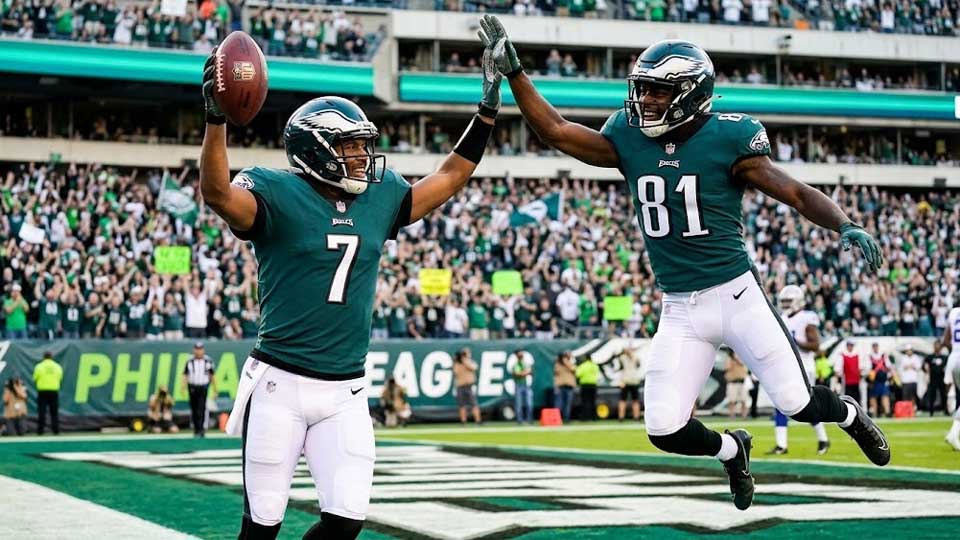
Using TriSync Sports to Find Quarterback and Receiver Combinations That Can Score Together
One of the most popular concepts in NFL DFS is also one of the easiest to understand. If you believe a quarterback is going to have a big game, why not pair him with the player catching his passes? That's the foundation of the:
QB Stack Strategy
A quarterback throws a touchdown.
He scores fantasy points.
His receiver catches that touchdown.
He scores fantasy points too.
One successful play produces fantasy points at two positions in your lineup.
That's correlation.
And in NFL DFS, correlation can be extremely valuable.
But there is an important difference between simply stacking two teammates and finding a good stack.
That's where TriSync Sports enters the picture.
Instead of saying:
“I like this quarterback, so I'll automatically use his WR1.”
we can ask:
Does TriSync like the quarterback?
Does TriSync also like one or more of his receivers?
Do their salaries work together?
Are their TriSync Value Projections attractive?
What do their Lineup Signals tell us?
When the answers begin lining up, we've found something much more interesting than a random stack.
We've found a:
TriSync-Supported QB Stack
What Is a QB Stack?
A basic QB stack combines:
1 Quarterback
with
1 pass catcher from the same team
Usually that means:
QB + WR
or
QB + TE
For example:
Quarterback + WR1
Quarterback + WR2
or
Quarterback + Tight End
The idea is simple.
When the pass catcher produces receiving yards, the quarterback usually receives passing-yard fantasy points on the same play.
When the receiver catches a touchdown, the quarterback generally receives credit for the passing touchdown.
One football play can improve two positions in your DFS lineup.
That's the appeal.
Why Stack at All?
Imagine you select a quarterback because you believe he's capable of throwing for 300 yards and three touchdowns.
That's great.
But where are those yards and touchdowns going?
Someone has to catch them.
If one of those players is also in your lineup, you're giving yourself the opportunity to benefit twice from the same offensive success.
Now imagine your quarterback throws two touchdowns to your stacked wide receiver.
Instead of hoping for eight unrelated players to independently produce strong performances, you've connected two of them.
The success of one can directly contribute to the success of the other.
That's why stacking has become such an important NFL DFS tournament concept.
But TriSync allows us to take the concept another step.
Don't Stack Just to Stack
This may be the most important rule in the entire strategy.
Correlation alone doesn't make a good lineup.
Suppose you love a quarterback's TriSync outlook.
His WR1, however, has:
A weak TriSync Projection.
An unattractive TriSync Value Projection.
A poor Lineup Signal.
And a salary that makes the rest of your lineup difficult to construct.
Should you automatically select that receiver simply because he's attached to your quarterback?
No.
You're forcing the stack.
Instead, look at the quarterback's other receiving options.
Maybe his WR2 has a much stronger TriSync outlook.
Maybe the tight end is sitting in an Excellent performance window.
Maybe a less expensive receiver carries a Value+ signal.
Or maybe this quarterback simply isn't the right player to stack this week.
The stack should improve the lineup.
The lineup shouldn't be weakened just so you can say you created a stack.
Start With the Quarterback
The quarterback is the foundation.
Begin with the:
This gives you the game-specific performance expectation.
Then examine:
Lineup Signal
Profile
Performance Window
Projected scoring range
Salary
and
Current football circumstances
A quarterback carrying a strong TriSync Projection immediately becomes interesting.
If he's also receiving a favorable DFS Lineup Signal?
Even better.
A Core quarterback could potentially become the centerpiece of multiple lineups.
A Premium quarterback may justify the higher salary because of his expected point production.
A Value+ or Value quarterback, a very rare instance, could create the salary flexibility necessary to spend more heavily at RB or WR.
The important point is:
Find the quarterback first.
Then determine whether his receiving options create an attractive stack.
Next, Examine Every Major Pass Catcher
Don't immediately jump to the team's most famous receiver.
Look at all of the realistic options.
That can include:
WR1
WR2
WR3
WR4
RB (if a passing target 5+ times per game)
and
Tight End
Now apply the same TriSync process.
What is the player's:
TriSync Projection?
TriSync Value Projection?
Lineup Signal?
Profile?
Performance Window?
Salary?
If the quarterback and one of his primary receivers both rate strongly?
Now the stack becomes interesting.
The Ideal TriSync QB Stack
There isn't one perfect formula.
But an especially attractive situation might look something like this:
Quarterback
TriSync Projection: Strong
Performance Window: Excellent
Profile: Aligned
Lineup Signal: Core
Wide Receiver
TriSync Projection: Strong
Performance Window: Good or Excellent
Profile: Aligned
Lineup Signal: Value+
Now we've got multiple things working together.
The quarterback has a strong individual outlook.
The receiver has a strong individual outlook.
Their fantasy production is correlated.
And the receiver may provide enough salary value to make the entire combination affordable.
That's much stronger than stacking two players simply because they wear the same uniform.
The QB + WR1 Stack
This is the most obvious version.
Take the quarterback and pair him with his team's primary receiver.
Why?
Because WR1 frequently represents one of the quarterback's largest sources of:
Targets
Receiving yards
Red-zone opportunities
and
Touchdowns
If TriSync strongly supports both players, this can become one of the cleanest stacks available.
The problem?
Everybody else can see it too.
The QB and WR1 may both carry expensive salaries.
They may also be extremely popular.
That doesn't make the combination bad.
But especially in a large tournament, we should consider whether another version of the stack provides greater value or differentiation.
The QB + WR2 Stack
This can become very interesting.
The team's WR2 may cost considerably less than WR1.
If his TriSync Projection and Value Projection are strong, you may be able to obtain much of the same game correlation at a lower salary.
That savings could allow you to upgrade:
RB1
RB2
another WR
TE
or
FLEX
This is exactly where the TriSync Value Projection can help.
We're not simply asking:
“Which receiver is better?”
We're asking:
“Which receiver creates the best DFS opportunity as part of this stack?”
Those aren't always the same answer.
The QB + TE Stack
Don't overlook tight end.
In fact, there will be weeks when the tight end is the most attractive stacking partner.
A TE may offer:
A lower salary.
Strong red-zone involvement.
A favorable TriSync Projection.
An attractive Lineup Signal.
And less popularity than the team's primary receiver.
If the TE carries a Value+ or Value designation while the quarterback also rates strongly, that combination deserves serious consideration.
It can also solve another problem.
You have to fill the TE position anyway.
If you can fill it with a strong TriSync play that also correlates with your quarterback, you've accomplished two things with one roster decision.
The QB + Lower-Cost Receiver Stack
Here's where things can get fun.
Sometimes the best stack won't involve the biggest name.
Suppose:
WR1 costs $8,000
and
WR2 costs $5,100
WR1 may have the higher raw TriSync Projection.
But WR2 might carry the stronger TriSync Value Projection and a Value+ Lineup Signal.
If the difference in expected production isn't enormous, the $2,900 savings could completely change the lineup.
You might turn:
A mediocre RB2 into a Premium RB.
A weak FLEX into a Core player.
A Punt selection into a Value+ player.
That's why stacks need to be evaluated as part of the entire lineup, not as isolated two-player combinations.
The QB + RB Stack
Sometimes, the QB may have a running back that is one of his favorite targets.
If the back is a passing target five or more times per game on average, he may be the one to stack, especially if he averages 0.3 or more receiving touchdowns per game.
A running back who knows how to run a disciplined route from just outside the red zone, or sneak open at the goal line, is a valuable passing weapon.
The bonus is that he has other ways to score as well.
TriSync Projection vs. TriSync Value Projection
Both measurements matter.
But they answer different questions.
TriSync Projection
How strongly is this player expected to perform in this game?
TriSync Value Projection
How attractive is that expected performance from a DFS value perspective?
When constructing a QB stack, start with the raw performance expectation.
Then examine the value.
You might discover:
QB A + WR A has the highest combined raw Projection.
But:
QB B + WR B has a nearly identical expected performance level while costing $2,000 less.
That second stack could create a much stronger total lineup.
Don't evaluate the stack in isolation.
Evaluate what the stack allows you to build around it.
Profile Type Can Strengthen the Stack
Profile becomes another useful layer.
An Aligned player has historically demonstrated a stronger relationship between his TriSync performance conditions and actual results.
A Variable player has shown less consistency relative to those conditions.
That doesn't mean we automatically need:
Aligned QB + Aligned WR
But when both players are Aligned and both carry strong TriSync Projections?
That's a particularly interesting combination.
You now have two correlated players whose individual TriSync signals have historically been more dependable.
That's something worth noticing.
Excellent + Excellent
One of the first combinations to search for is:
Excellent QB + Excellent Receiver
Especially if both players also have strong TriSync Projections.
But don't stop there.
Remember:
The performance window alone doesn't determine expected fantasy production.
A superstar receiver in a Good window can still carry a much stronger TriSync Projection than an average receiver in an Excellent window.
So don't simply search for matching labels.
Search for:
Strong Projection + Strong Projection
Then use the performance windows and profiles to add context.
Good + Excellent Can Be Just as Interesting
Your QB doesn't have to be in an Excellent window.
Neither does his receiver.
Suppose the quarterback is:
Good / Aligned
with an excellent TriSync Projection.
His WR1 is:
Excellent / Aligned
with another strong Projection.
That's still a very attractive stack.
The TriSync Projection already accounts for the individual player's historical performance pattern.
Use the Projection as the primary number.
Use the window to understand the conditions behind it.
What About a Variable Superstar?
Play him.
Don't let the profile label override obvious talent and production.
Suppose an elite quarterback has:
A tremendous TriSync Projection.
A favorable Lineup Signal.
A reasonable salary.
But a Variable profile.
That doesn't disqualify him.
The same applies to receivers.
Some great fantasy players can be Variable.
Profile is about confidence in the performance-cycle relationship.
It isn't a ranking of football talent.
Use it appropriately.
The Stack Must Fit the Salary Cap
This is where DFS strategy becomes a puzzle.
Imagine:
Stack A
QB: $8,000
WR: $8,500
Total: $16,500
Stack B
QB: $6,800
WR: $6,200
Total: $13,000
Stack A may carry stronger raw TriSync Projections.
But it costs $3,500 more.
What does that $3,500 force you to give up elsewhere?
That's the real question.
If Stack B allows you to move from:
Filler → Value+
at RB
and
Punt → Secondary
at FLEX,
the cheaper stack could produce the stronger overall lineup.
Never evaluate salary in a vacuum.
Lineup Signals Can Help Build the Stack
The TriSync DFS Lineup Signals make this process easier.
A QB stack might contain:
Core QB + Premium WR
or
Premium QB + Value+ WR
or
Value QB + Core WR
All three can make sense.
The Lineup Signals help explain what role each player can serve in the lineup.
They can also warn us about stacks we may be forcing.
If a receiver carries a Low Output, or Avoid signal, don't ignore that information simply because you want exposure to his quarterback.
The purpose of the stack is to create an advantage.
Not an excuse.
The Battle and Tough D Signals Matter at Quarterback
Quarterback has another important consideration.
The opposing defense.
A quarterback carrying a Battle designation may be relatively evenly matched with the defense he's facing.
A Tough D signal tells us the quarterback may be facing a particularly difficult situation.
That doesn't automatically eliminate the QB.
But it should influence how aggressively we're willing to build around him.
If another similarly priced quarterback carries:
A stronger TriSync Projection.
A better Value Projection.
A more favorable Lineup Signal.
And an attractive receiver to stack with him?
That's a meaningful difference.
Don't Forget the Receiver's Individual Opportunity
Correlation doesn't replace opportunity.
Before using a receiver in the stack, make sure he's actually positioned to participate.
Check:
Expected role
Targets
Injury status
Depth-chart position
Recent usage
and
Quarterback situation
A receiver with a terrific TriSync Projection isn't useful if new information indicates he's going to play only a handful of snaps.
TriSync provides the performance layer.
Current football information confirms the opportunity.
Use both.
QB Stacking in Cash Games
You can use a QB stack in cash contests.
But you don't need to force one.
Cash games are primarily about building a dependable lineup capable of beating a large portion of the field.
If your highest-confidence QB and one of his receivers both carry:
Strong TriSync Projections.
Dependable roles.
Strong floors.
And favorable salaries.
Stacking them can make sense.
But don't sacrifice a clearly superior individual play just to create correlation.
In cash:
Projection and reliability come first.
Correlation is a bonus.
QB Stacking in GPP Tournaments
Now the strategy becomes much more powerful.
Large-field tournaments reward ceiling.
You're trying to build a lineup capable of producing an unusually high total.
If your quarterback has a monster game and your receiver catches a large portion of that production, both roster positions can climb together.
That's exactly what we want.
Tournament stacking can also create differentiation.
Maybe the obvious QB + WR1 combination is extremely popular.
But TriSync identifies:
QB + WR2
or
QB + TE
as an attractive alternative.
Now you've maintained the correlation while potentially building a less common lineup.
That's where stacking and leverage begin working together.
One Stack Is Enough for This Strategy
The basic QB Stack Strategy doesn't need to become overly complicated.
Start with:
QB + ONE PASS CATCHER
That's it.
There will be another strategy for the more aggressive:
Double Stack
QB + two pass catchers.
And another strategy for:
Game Stack/Bring-Back
QB + pass catcher + opposing player.
Those deserve their own analysis.
For the basic QB Stack Strategy, keep the concept clean.
Find the quarterback.
Find his best TriSync-supported receiving partner.
Build the rest of the lineup.
QB Stack + Marquee & Marginal
The strategies can also work together.
Suppose you select a very expensive:
Premium QB
and
Premium WR1
That's your Marquee combination.
Now the rest of the lineup may require lower-cost pieces.
Use the TriSync Value Projection and Lineup Signals to find:
Value+
Value
or carefully selected lower-cost options.
Instead of filling the lineup with cheap players simply because you ran out of salary, you're searching for less expensive players whose TriSync outlook supports the savings.
That's a much stronger way to build around an expensive stack.
QB Stack + TriSync Value
The opposite construction can be equally interesting.
Maybe your quarterback carries a Value+ signal.
His WR2 carries Value+.
Together, they create an inexpensive stack with strong TriSync Projections.
Now you've saved enough salary to pay for:
A Premium RB.
An elite WR.
A high-ceiling FLEX.
Potentially several of them.
The stack itself becomes the salary-saving mechanism.
That's another reason not to assume the best QB stack always contains the most expensive quarterback and WR1.
When NOT to Stack
There will be slates when the strategy doesn't fit.
Don't force a QB stack when:
The quarterback rates strongly but none of his receivers do.
The receiver you want is overpriced relative to his TriSync Value Projection.
The stack forces too many weak selections elsewhere.
Late injury information changes the receiver's role.
Another quarterback/receiver combination is clearly superior.
Or simply:
The TriSync numbers don't support it.
A strategy should guide your lineup construction.
It shouldn't imprison it.
A Simple TriSync QB Stack Example
Imagine this hypothetical DFS situation:
QB A
Salary: $7,200
TriSync Projection: 6.05
Profile: Aligned
Window: Excellent
Lineup Signal: Core
His receivers:
WR1
Salary: $7,800
TriSync Projection: 5.90
Profile: Aligned
Window: Good
Lineup Signal: Premium
WR2
Salary: $5,400
TriSync Projection: 5.65
Profile: Aligned
Window: Excellent
Lineup Signal: Value+
TE
Salary: $4,100
TriSync Projection: 4.70
Profile: Variable
Window: Good
Lineup Signal: Value
Which stack should we use?
There isn't automatically one answer.
QB + WR1 gives us the strongest raw Projection.
QB + WR2 gives us nearly as much projected production while saving $2,400.
QB + TE saves even more salary but sacrifices additional Projection.
Now we look at the rest of the lineup.
If that $2,400 savings from WR2 allows us to make two major upgrades elsewhere?
QB + WR2 may be the strongest overall lineup decision.
That's TriSync stacking.
We're not just identifying correlation.
We're evaluating:
Correlation + Projection + Value + Salary + Total Lineup Construction.
The QB Stack Checklist
Before locking in a stack, ask:
1. Does the quarterback have a strong TriSync Projection?
Start there.
2. What is the quarterback's TriSync Value Projection?
Make sure the salary makes sense.
3. What does his Lineup Signal tell me?
Core? Premium? Value+? Value? Battle? Tough Spot?
4. Which pass catcher has the strongest TriSync outlook?
Don't automatically choose WR1.
5. Does that receiver have enough opportunity?
Targets and role still matter.
6. Are both players Aligned?
If so, that can increase confidence in the TriSync signals.
7. What are their performance windows?
Excellent and Good combinations deserve attention.
8. What does the stack cost?
Always evaluate the combined salary.
9. What does that salary force me to do elsewhere?
The rest of the lineup matters.
10. Am I stacking because the numbers support it or simply because I want a stack?
This may be the most important question.
The Real Goal: Find Two Players Who Can Win Together
That's the heart of QB stacking.
We're not selecting two players because they're teammates.
We're selecting them because their fantasy outcomes can be connected.
Then TriSync helps us determine whether each player is individually attractive.
That's the difference.
Traditional stacking asks:
“Which receiver should I pair with my quarterback?”
The TriSync QB Stack Strategy asks:
“Which quarterback and receiver combination gives me the strongest blend of correlation, projection, value and salary?”
That's a much better question.
Conclusion: Correlate the Opportunity
NFL DFS opens up the opportunity to stack, because one play can score points for multiple players in your lineup.
Take advantage of it.
Start with the quarterback.
Check his:
TriSync Projection
TriSync Value Projection
Lineup Signal
Profile
Performance Window
and
Salary
Then examine his receivers.
Don't automatically choose WR1.
Compare the wide receivers.
Check the tight end.
Check an RB if he is a passing target 5+ times per game.
Look for Value+ opportunities.
Look for strong Aligned profiles.
Look for players in favorable performance conditions.
Then calculate what the stack allows you to do with the rest of the lineup.
The goal isn't simply:
QB + WR1.
The goal is:
The right QB + the right receiver + the right salary combination.
When the quarterback succeeds, you want his receiver succeeding with him.
When the touchdown comes, you want points hitting two places in your lineup.
Find the quarterback.
Find the connection.
Confirm the TriSync support.
Stack the opportunity.
That's the TriSync Sports QB Stack Strategy.
Bet responsibly. Past performance of any analytical system does not guarantee future results. TriSync Sports is intended as an informational and entertainment tool.