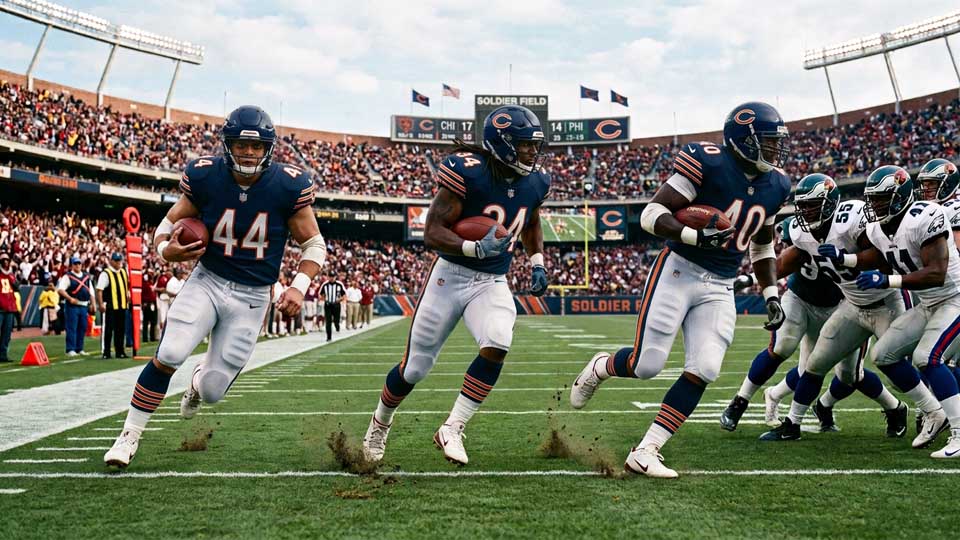
Control the Running Back Market and Build From a Position of Strength
Running back is one of the most difficult positions to manage in fantasy football.
It is also one of the most valuable.
Top running backs can produce huge weekly totals, dominate touches, catch passes, score touchdowns and create a major advantage over weaker RB rooms.
But there is another reason running back matters:
Scarcity.
Every fantasy manager needs them.
You start two running backs every week.
Your Flex can also be a running back.
And when injuries begin piling up during the NFL season, the number of trustworthy options usually gets smaller.
The RB Fortress Draft Strategy attacks that scarcity before it becomes a problem.
Instead of waiting on running backs, you draft them aggressively.
You build a deep RB room early.
You secure multiple starters.
You create injury protection.
And, just as importantly, you reduce the number of quality running backs available to the rest of the league.
The strategy is simple:
Build the fortress first.
Then fill in the rest of the roster around it.
With TriSync Sports, the foundation of the strategy begins with the same key draft statistic used in our other approaches:
Overall Average (Overall Avg).
Overall Avg reflects how a player has performed in NFL Fantasy over the previous 365 days.
When building an RB Fortress, that number helps identify which running backs have actually delivered the strongest fantasy production.
You are not drafting running backs just because they play the position.
You are trying to draft the right running backs before everyone else does.
What Is the RB Fortress Strategy?
The RB Fortress Strategy is built around using multiple early-round selections on running backs.
Instead of drafting:
RB – WR – WR – TE
you might begin:
RB – RB – RB – WR
or:
RB – RB – WR – RB
or even:
RB – RB – RB – RB
depending on value and how aggressively the league is drafting the position.
The exact sequence is flexible.
The philosophy is not.
You want to leave the early portion of the draft with significantly more running back strength than most of your opponents.
That gives you:
Strong weekly starters
Flex options
Injury protection
Trade leverage
and
Control over a scarce position
The rest of the roster gets built afterward.
Why Call It a Fortress?
Because you're not simply drafting a good starting pair.
You're building layers.
Your RB1 is strong.
Your RB2 is strong.
Your RB3 may be capable of starting in your Flex spot.
Your RB4 may be good enough to start for someone else.
And if one player gets injured, the structure doesn't collapse.
That's the fortress.
The strategy is designed to withstand the volatility of the position by owning enough quality backs that one injury doesn't destroy your season.
At the same time, your opponents may be forced to rely on weaker RB options because several of the players they wanted are sitting on your roster.
The TriSync RB Fortress Formula
The TriSync version of RB Fortress can be summarized as:
Elite RB production + RB depth + scarcity control + later-round value at other positions
The first two pieces are obvious.
The third is what makes the strategy different.
You aren't only trying to improve your own team.
You're influencing the draft room.
Every time you select another strong running back, one less running back is available to your opponents.
That matters in a format where every team needs to start two.
Why Overall Average Is Critical
An RB Fortress should be built on production, not position labels.
There is no advantage in drafting four running backs early if two of them have mediocre fantasy production.
That's why Overall Avg becomes so important.
Overall Avg gives you a direct look at how each player has performed in NFL Fantasy over the previous 365 days.
Use it to compare running backs within the same tier.
If one player has a significantly stronger Overall Avg than another, that deserves attention.
If two players are nearly identical, profile type can become a tiebreaker.
But the fundamental rule remains:
Draft production first.
The goal is not to draft the most running backs.
The goal is to draft the most useful running backs.
Overall Average vs. TriSync Projection
As with the Standard, RB Hero and Zero RB strategies, the current TriSync Projection should not drive your draft.
The Overall Avg is the key season-long draft measurement.
The TriSync Projection is primarily a weekly decision-making tool.
A running back may currently sit in an Excellent, Good, Fair or Suboptimal performance cycle.
That matters more when you're deciding whether to start him in a particular week.
It matters much less when you're deciding whether to draft him for an entire season.
Draft with Overall Avg.
Manage with TriSync Projection.
Aligned vs. Variable Running Backs
Profile type still has value.
An Aligned running back has historically shown greater consistency relative to his TriSync performance cycles.
That can make him easier to evaluate from week to week.
A Variable player has shown more volatility.
In an RB Fortress, Aligned players can be especially attractive because you may have several legitimate weekly options.
If two running backs have similar Overall Avg values, the Aligned player may be preferable because he gives you a stronger weekly signal.
But do not make the mistake of passing on elite Variable production.
If a Variable running back ranks near the top of the position in Overall Avg, draft him.
The hierarchy remains:
Overall Avg first.
Profile type second.
Round 1: Start the Fortress
Target: Elite running back
Your first selection should usually be a premium RB.
Look at Overall Avg (Typically, Overall Avg >= 5.50).
Identify the top tier.
You want a player with strong fantasy production and a major role.
This is the foundation of the entire strategy.
You are not looking for a respectable RB1.
You are looking for a cornerstone.
Round 2: Add Another Wall
Target: RB2
This is where the RB Fortress begins to separate from a Standard Strategy.
Most managers may begin thinking about wide receiver.
You continue building running back strength.
Take another high-quality RB if the value supports it.
Now you've secured both starting running back positions.
That's already valuable.
But you're not finished.
Round 3: Create the Pressure
Target: RB3 or elite WR value
This is one of the most important rounds in the strategy.
If another high-quality running back is available, strongly consider taking him.
Now you may have:
RB1
RB2
RB3/Flex
That gives you three potential weekly starters before some teams have even secured two.
At the same time, remain flexible.
If an elite wide receiver falls far below expectation, take the value.
RB Fortress is aggressive.
It should not be blind.
Round 4: Complete the Core
Target: RB4 or WR1
Depending upon the board, this is where you may select your fourth running back.
That sounds extreme.
It is supposed to.
The RB Fortress Strategy is built around aggressively creating a positional advantage.
If you come out of four rounds with:
4 RB
you have built enormous depth.
If you come out with:
3 RB + 1 WR
you've still created a strong fortress while beginning to balance the roster.
Both constructions can work.
The deciding factor should be value.
What If Everyone Else Starts Drafting RBs?
Good.
That means the strategy is affecting the room.
But don't get caught in a panic.
If the running backs remaining no longer justify the draft cost, stop.
This strategy works when you are drafting quality.
It fails when you reach for inferior players simply to keep the fortress theme going.
The objective is not:
Take RB at all costs.
The objective is:
Take strong RB value before it disappears.
Rounds 5–7: Build the Wide Receiver Room
Target: WR1, WR2 and WR3
Once you’ve established your running back foundation, wide receiver becomes the priority.
This is the tradeoff.
You spent premium picks on RB.
Now you need to find strong receiver value.
Fortunately, wide receiver is generally a deeper position.
There are usually productive options available beyond the earliest rounds.
Use Overall Avg to identify players whose recent fantasy production exceeds their current draft cost.
This is where you may find veterans who have been overlooked because the room spent the early rounds chasing younger names.
You don't need the flashiest receiver.
You need points.
Can You Still Draft an Elite WR Early?
Absolutely.
RB Fortress is not a rigid script.
Suppose you take RBs in Rounds 1 and 2.
Round 3 arrives and an elite wide receiver falls unexpectedly.
Take him.
Then return to RB later if the value is still there.
A strong RB Fortress may look like:
RB – RB – WR – RB
instead of:
RB – RB – RB – RB
Both accomplish the same basic goal.
You are still prioritizing running back more aggressively than the rest of the league.
Rounds 6–8: Quarterback and Tight End Enter the Picture
Target: QB, TE and WR depth
By this stage, you need to start filling out the rest of the starting lineup.
If a quality quarterback is available at appropriate value, take him.
If a tight end with a strong Overall Avg provides a meaningful advantage over the remaining tier, take him.
But continue watching wide receiver.
Your RB Fortress only works if the rest of the roster remains competitive.
You are not trying to build a team that wins RB and loses everywhere else.
You are trying to build a team that dominates RB and remains strong enough everywhere else.
The Flex Position Can Make the Fortress Even Stronger
The Flex position can be filled by:
RB
WR
or
TE
That gives RB Fortress managers another advantage.
Your RB3 does not need to sit on the bench.
If he has stronger projected production than your WR3, start him at Flex.
That means your weekly lineup could include:
RB1
RB2
RB3 at Flex
Three running backs.
If those three players all carry strong Overall Avg values, that can become a major weekly advantage.
The Hidden Advantage: Injury Protection
Running back injuries are one of the biggest reasons fantasy seasons go sideways.
A Standard roster may have two good backs and one decent backup.
If RB1 gets injured, the entire lineup changes.
An RB Fortress may contain four or five playable running backs.
One injury hurts.
It does not destroy the roster.
You simply move the next player up.
That is one of the biggest strengths of the strategy.
Depth is not just insurance.
It is structural protection.
Rounds 9–11: Keep Adding Value
Target: WR depth, TE depth, QB if needed, and another RB if value appears
By this stage, your roster should be more balanced.
You should have several running backs and multiple receivers.
Now focus on value.
If another running back with a strong Overall Avg falls too far, take him.
There is no rule that says five running backs is too many.
If the player has meaningful trade or starting value, he can still improve your roster.
But don't ignore other needs.
Fill in QB.
Fill in TE.
Build WR depth.
The fortress is already standing.
Now decorate the castle.
RB5 Can Be More Than a Backup
Your fifth running back may never start for you.
That's okay.
He may still have tremendous value.
Why?
Because another fantasy manager may lose a starter.
Or discover that his RB2 is barely playable.
Now your RB5 may be better than his RB2.
That gives you leverage.
You can trade from strength.
Your goal is not to hoard players for no reason.
Your goal is to own valuable assets.
Running backs often become more valuable as the season progresses.
Trade Leverage Is Part of the Strategy
This is one of the most interesting features of RB Fortress.
Fantasy managers frequently become desperate for running back help.
Injuries happen.
Depth charts change.
Poorly drafted RB rooms become obvious.
If you own four or five useful running backs, you may have something other managers badly need.
That gives you trade power.
You may eventually move an RB for:
A stronger wide receiver
A tight end upgrade
A quarterback upgrade
or
A two-for-one roster improvement
In other words, the fortress can eventually fund the rest of the team.
Do Not Trade Too Early
There is a temptation to draft RB-heavy and immediately start shopping players.
Be careful.
Your depth has value.
You built it for a reason.
Before trading, make sure you are improving the roster enough to justify weakening the fortress.
If you trade away your RB4 in September and then lose two starters to injury, the deal may look much worse a few weeks later.
Depth becomes more valuable during the season.
Do not give it away cheaply.
Rounds 12–14: Upside and Final Depth
Target: WR upside, TE/QB insurance and RB value
Now you are filling the bench.
Look for players with paths to increased roles.
Wide receiver is especially important because your early RB focus may have left you with less receiver depth than a Standard or Zero RB roster.
Use these rounds to add upside.
You can still draft another running back if the value is strong.
But by now, your remaining selections should primarily strengthen weaknesses elsewhere.
Round 15: Kicker
Target: Secure kicker on a productive offense
As with the other strategies, wait on kicker.
Use your earlier selections on positions where scarcity and upside matter more.
Draft a kicker with a stable role and strong scoring opportunities.
Then move on.
Round 16: Defense/Special Teams
Target: Strong D/ST with favorable early-season value
Use the NFL Team Projections report to evaluate available team units.
Defense/Special Teams should usually remain your final selection.
Draft a strong option.
Then be willing to implement a revolving D/ST strategy from week to week throughout the season.
What Should an RB Fortress Roster Look Like?
One possible 15-player construction is:
QB: 1
RB: 6
WR: 5
TE: 2
K: 1
Then add:
D/ST: 1
Another possible construction:
QB: 1
RB: 5
WR: 6
TE: 2
K: 1
D/ST: 1
The exact total depends on how the draft unfolds.
But compared with a Standard roster, the RB Fortress should normally contain one additional high-quality running back.
More importantly, several of those backs should have been drafted early enough to carry legitimate starting value.
Why Five or Six Running Backs Makes Sense
You start two running backs.
Your Flex can also be an RB.
Running backs suffer injuries at a high rate.
And strong running backs often become difficult to replace during the season.
That gives the position unusual roster value.
Owning five or six backs may seem excessive in August.
It often feels much less excessive by October.
What Kind of Running Backs Should You Target?
Not every running back belongs in the fortress.
Look for players who offer multiple paths to fantasy points.
High Touch Volume
Touches create opportunity.
Running backs who receive both carries and receptions are especially attractive.
Red-Zone Opportunity
Touchdowns can create huge fantasy swings.
Running backs trusted near the goal line deserve attention.
Receiving Ability
Pass-catching backs can remain useful even when rushing production drops.
Secure Roles
The earlier you draft a running back, the more you want clarity.
Avoid paying premium prices for uncertain workload unless the upside is exceptional.
Strong Overall Avg
This is still the foundation.
You want backs who have demonstrated fantasy production.
Aligned Running Backs Can Make the Fortress Easier to Manage
An RB-heavy roster creates weekly decisions.
You may have three or four players who could realistically start.
That's where Aligned profiles can be useful.
Suppose two running backs have similar Overall Avg values.
One is Aligned.
One is Variable.
If the Aligned player also carries a stronger weekly TriSync Projection, that can provide a useful edge when deciding who belongs in the lineup.
This is exactly where TriSync adds value beyond the draft.
You created the depth.
The weekly data helps you use it.
Your RB3 and RB4 Should Not Rot on the Bench
Depth only matters if you use it intelligently.
If your RB3 consistently produces at a high level, consider him at Flex.
If your RB4 becomes more valuable than your WR2, adjust.
If another manager offers meaningful value in a trade, listen.
The RB Fortress is not about stubbornly keeping every running back forever.
It is about controlling valuable assets.
When RB Fortress Goes Wrong
No strategy is perfect.
RB Fortress has several clear risks.
Your Wide Receiver Room Becomes Too Weak
This is the biggest danger.
If you spend four early picks on RB, you may miss elite WR talent.
You need to find receiver value later.
Your RBs Underperform
Drafting multiple players at one position amplifies the risk if that position disappoints.
You Reach Too Far
This destroys the strategy.
Taking a mediocre RB over a clearly superior WR simply because you want another running back is poor drafting.
You Fail to Use Trade Leverage
If you build an overloaded RB room but never use the depth to strengthen other positions, some of that value may remain trapped on the bench.
When to Stop Building the Fortress
This is critical.
Stop when the value stops.
Suppose you have three running backs after three rounds.
In Round 4, the best remaining RB is clearly inferior to an available WR.
Take the receiver.
You have already established the positional advantage.
There is no benefit in weakening your roster just to draft a fourth running back.
The fortress should be strong.
It does not need to be ridiculous.
When to Abandon the Strategy Completely
Sometimes the draft room will make RB Fortress impossible.
Maybe running backs are flying off the board.
Maybe the value simply isn't there.
Maybe elite WRs keep falling to you.
Adapt.
A good fantasy manager does not enter the draft determined to force one philosophy.
Use the strategy when the board supports it.
Change when the board does not.
If you begin RB Fortress and later transition toward a more Standard build, that's perfectly fine.
The purpose of strategy is to create an edge.
Not to prove that you can follow a label.
RB Fortress vs. RB Hero
RB Hero says:
Draft one elite running back, then wait.
RB Fortress says:
Draft one elite running back, then keep going.
RB Hero uses early capital to strengthen other positions.
RB Fortress uses early capital to dominate RB.
RB Hero aims to solve RB2 later.
RB Fortress tries to solve RB1, RB2 and potentially Flex immediately.
The tradeoff is obvious.
RB Hero usually builds a stronger WR room early.
RB Fortress builds much stronger running back depth.
RB Fortress vs. Zero RB
These strategies could not be more different.
Zero RB says:
Running backs are volatile, so don't pay early prices.
RB Fortress says:
Running backs are scarce, so secure them before everyone else does.
Both philosophies are reacting to the same position.
They're simply reaching opposite conclusions.
Zero RB tries to exploit late opportunity.
RB Fortress tries to control early supply.
That's why these strategies make such an interesting contrast.
RB Fortress vs. Standard Strategy
The Standard Strategy seeks balance.
RB Fortress creates deliberate concentration.
A Standard roster might leave six rounds with:
2 RB
2 WR
1 QB
1 TE
An RB Fortress roster might leave with:
3 RB
2 WR
1 TE
or:
4 RB
2 WR
The RB Fortress roster sacrifices some early balance in exchange for positional dominance.
The question is whether you can find enough value later at wide receiver, quarterback and tight end.
If you can, the roster becomes extremely difficult to attack.
The Real Bet Behind RB Fortress
The strategy is making a simple wager:
Quality running backs will become more valuable as the season progresses.
If you're right, owning several gives you a major advantage.
You have starters.
You have injury protection.
You have Flex options.
You have trade assets.
And other managers may be forced to scramble for the position you already control.
That is the fortress.
Your TriSync RB Fortress Draft Checklist
During the early rounds:
1. Does the running back have a strong Overall Avg?
Do not draft the position blindly.
2. Does he have a meaningful role?
Touches matter.
3. Am I still getting value?
Do not reach.
4. Is an elite WR falling too far?
Take advantage when necessary.
After building the core:
5. Is my WR room becoming too weak?
Correct the imbalance.
6. Do I have a starting QB and TE plan?
The rest of the roster still matters.
7. Does my RB depth create Flex options?
Use the strength.
During the later rounds:
8. Can this player increase in value?
Draft upside.
9. Am I protecting against injury without wasting roster spots?
Depth should have purpose.
10. Does another manager eventually need what I own?
That's where trade leverage begins.
After the Draft: Manage the Fortress
The strategy does not end when the draft finishes.
Once the season begins, use TriSync data to help determine which running backs deserve to start.
Compare:
Overall Avg
Current TriSync Projection
Excellent, Good, Fair or Suboptimal cycle
Aligned or Variable profile
Expected workload
Recent usage
Your RB1 may be automatic.
RB2 and Flex may not be.
If you have three or four strong options, TriSync can help separate them.
That's the advantage of depth.
You don't have to force a weak starter into the lineup.
You have alternatives.
Conclusion: Own the Position Everyone Else Needs
RB Fortress is not a conservative draft strategy.
It is aggressive by design.
You are intentionally using premium draft capital to control one of the most important and scarce positions in fantasy football.
You secure elite running backs early.
You build depth.
You create Flex options.
You protect against injury.
And you potentially create trade leverage as the season develops.
TriSync Overall Avg helps identify the running backs whose recent fantasy production justifies that investment.
Aligned profiles can help break ties.
Variable stars remain valuable when their production is elite.
And once the season begins, the weekly TriSync Projection can help you decide which members of the fortress actually belong in the starting lineup.
The strategy is not about hoarding running backs.
It is about controlling valuable fantasy assets.
Build the fortress early.
Fill the roster around it.
Then make the rest of the league come looking for what you already own.
That's the TriSync Sports RB Fortress Draft Strategy.
Bet responsibly. Past performance of any analytical system does not guarantee future results. TriSync Sports is intended as an informational and entertainment tool.