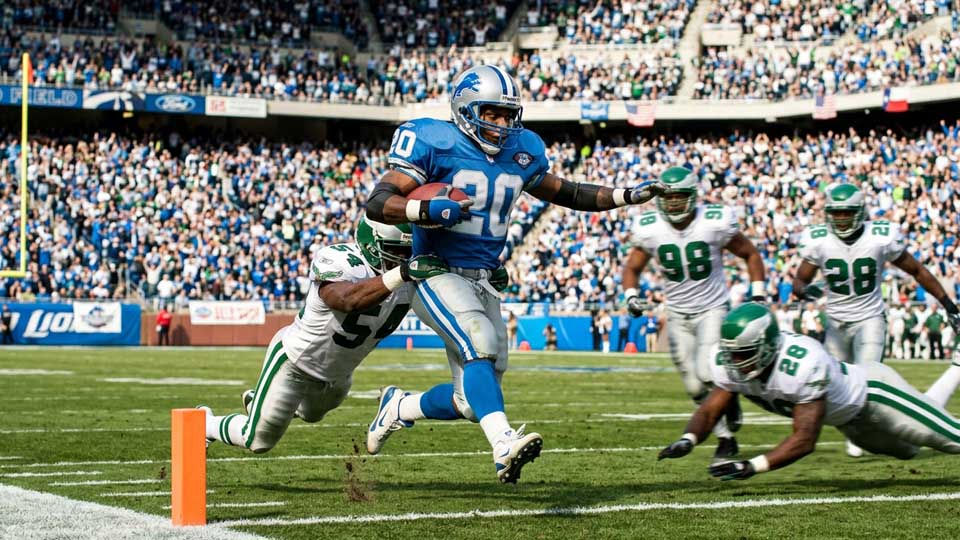
Secure One Elite Running Back, Then Build Strength Everywhere Else
Running back presents one of the biggest dilemmas in fantasy football.
Elite running backs can provide an enormous weekly advantage.
But the position is also filled with uncertainty. Injuries happen. Workloads change. Backfields become committees. Players who appear buried on a depth chart in August can suddenly become valuable fantasy starters in October.
The RB Hero Draft Strategy tries to capture the best of both worlds.
The philosophy is simple:
Draft one elite running back early.
That's your Hero.
Then resist the temptation to immediately draft another running back.
Instead, spend the next several rounds building strength at wide receiver, tight end and quarterback before returning to running back later in the draft.
The result is a roster anchored by one premium RB1, surrounded by high-level talent at the other offensive positions.
With TriSync Sports, the key to identifying that Hero starts with one number:
Overall Average (Overall Avg)
Overall Avg reflects how a player has performed in fantasy over the previous 365 days.
For the RB Hero strategy, that's particularly important.
You're putting a lot of responsibility on one running back.
Make sure he's worthy of the cape.
What Is the RB Hero Strategy?
RB Hero, sometimes called Anchor RB, is a fantasy draft strategy built around selecting one premium running back with an early pick and then delaying your second running back.
Instead of beginning your draft:
RB – RB – WR – WR
you might start:
RB – WR – WR – TE
or:
RB – WR – WR – QB
or even:
RB – WR – TE – WR
The exact sequence isn't important.
The philosophy is.
Once you've secured your RB Hero, you temporarily move away from running back and use the valuable middle portion of the draft to accumulate talent elsewhere.
Eventually, you'll return to running back and attack the position with multiple candidates for your RB2 spot.
You don't need all of those later running backs to become stars.
You already have your star.
You need to find one reliable RB2.
That's what separates RB Hero from Zero RB.
RB Hero Is NOT Zero RB
The two strategies share some DNA, but there is one enormous difference.
With Zero RB, you're intentionally avoiding running backs during the early portion of the draft.
With RB Hero, you're doing almost the opposite with your first running back.
You're deliberately acquiring an elite one.
Then you stop.
The Zero RB manager will eventually need to discover two starting running backs from the middle rounds, late rounds or waiver wire.
The RB Hero manager already owns one.
You only need to solve RB2.
That's a much smaller problem.
And while you're waiting to solve it, you're accumulating premium wide receivers and potentially an elite quarterback or tight end.
The TriSync RB Hero Formula
The TriSync version of RB Hero can be summarized very simply:
One elite RB + WR strength + positional advantages + multiple RB2 candidates
The entire strategy depends upon the first part.
Your Hero can't simply be a running back you happen to draft in Round 1.
He needs to deserve the designation.
That's where the TriSync Overall Avg becomes particularly valuable.
Overall Avg measures a player's fantasy performance over the previous 365 days, which at draft time is his performance in the previous season.
When you're evaluating potential RB Heroes, look toward the top of the running back Overall Avg rankings.
You're looking for demonstrated fantasy production.
Not simply reputation.
Not simply projected touches.
Not simply ADP.
Production.
If you're going to build an entire draft strategy around one premium running back, he should have the numbers to justify it.
What Makes a Good RB Hero?
Your ideal Hero should possess several characteristics.
First, he should have an elite or near-elite Overall Avg among running backs.
That's the starting point.
Next, you want opportunity.
A running back who receives significant rushing attempts, catches passes and gets opportunities near the goal line has multiple ways to generate fantasy points.
That's exactly what you want from your Hero.
You don't want to build this strategy around a running back whose fantasy production depends heavily upon one particular game script.
You want a player capable of producing when his team is ahead, behind or playing a close game.
Finally, look at his TriSync profile.
If your potential Hero is Aligned, that's an added benefit.
Aligned players have historically demonstrated greater consistency relative to their TriSync performance cycles.
That potentially makes your Hero easier to evaluate once the season begins.
But remember the rule from our Standard Draft Strategy:
Don't pass on elite production simply because a player is Variable.
If one of the highest-rated running backs by Overall Avg carries a Variable profile, he's still absolutely capable of being your Hero.
Overall Avg comes first.
Profile type comes second.
Overall Average Matters More Than the Current TriSync Projection
This distinction remains important with RB Hero.
The TriSync Projection can change from week to week depending upon a player's current Excellent, Good, Fair or Suboptimal performance cycle and his historical results within those conditions.
That's extremely useful once the season begins.
It isn't a tool for selecting your Hero during the draft.
You're drafting him for an entire season.
A running back sitting in a Fair cycle today could be in an Excellent cycle a few weeks from now.
His current TriSync Projection shouldn't cause you to pass on a player with elite season-long fantasy production.
For the draft:
Prioritize Overall Avg.
During the season:
Bring the TriSync Projection into your weekly decisions.
That's particularly important with the running backs you'll eventually draft behind your Hero.
Round 1: Find Your Hero
Target: One elite running back
This is the ideal place to secure your Hero.
Use TriSync's running back Overall Avg rankings to identify the premium tier.
You're looking for separation.
If several running backs sit substantially above the rest of the position in Overall Avg, those are your primary Hero candidates. (Typically, Overall Avg >= 5.50)
Your objective isn't simply to draft an RB in Round 1.
It's to draft an RB capable of giving you a weekly advantage.
There's a major difference.
If the true Hero candidates are already gone when your selection arrives, don't force the strategy.
RB Hero only works if you've actually got a Hero.
Drafting a second-tier running back simply because you decided before the draft that you're using RB Hero defeats the entire purpose.
Take the best available player and consider another strategy.
The strategy serves the draft. The draft doesn't serve the strategy.
Round 2: Step Away From Running Back
Target: Premium wide receiver
You've got your Hero.
Now the strategy begins.
Your natural instinct may be to grab another strong running back and lock down the position.
Resist it.
Wide receiver should generally become your primary target.
Look at the strongest remaining receivers by Overall Avg.
If a premium WR is sitting there, take him.
You're trying to create a roster where the advantage you are surrenduring at RB2 is compensated for by superior production elsewhere.
Your Hero protects RB1.
Now start building your WR room.
Round 3: Keep Building WR Strength
Target: WR2 or elite positional value
Wide receiver remains the preferred target.
Coming out of three rounds with:
1 elite RB + 2 premium WRs
is an excellent RB Hero foundation.
But don't become unnecessarily rigid.
If an elite tight end has fallen into your lap, consider him.
If a quarterback capable of creating a major weekly positional advantage is available at exceptional value, he deserves consideration.
The principle is more important than the position:
Don't draft RB2 yet unless the value becomes impossible to ignore.
Use the draft capital elsewhere.
Rounds 4–6: Build Advantages Around Your Hero
Target: WR depth, TE and QB
These rounds are where RB Hero can become dangerous for your opponents.
While other managers continue spending selections on RB2 and RB3, you're building the rest of your starting lineup.
Ideally, you're accumulating some combination of:
WR3
WR4
Starting TE
Starting QB
This is also where Overall Avg becomes useful across positions.
You're looking for proven fantasy production that the draft room may be undervaluing.
Suppose the available RBs have mediocre Overall Avg numbers while a receiver with significantly stronger production remains available.
Take the receiver.
Remember:
You're intentionally accepting weakness at RB2 for now.
In exchange, you're creating strength elsewhere.
That's the trade.
Don't Be Afraid of a Powerful Flex
The Flex position is one reason RB Hero can work particularly well with this roster format.
You start:
2 RB
2 WR
1 Flex
Your Flex can be an RB, WR or TE.
There is no requirement that it be another running back.
That means a roster beginning with one RB Hero and several strong receivers can still produce a powerful weekly starting lineup.
Imagine leaving the early rounds with:
1 elite RB
3 strong WRs
1 premium TE
1 strong QB
Your RB2 may be weaker than the RB2 on some competing rosters.
That's intentional.
You expect to compensate with stronger production at WR, TE, QB and possibly Flex.
Then you attack the RB2 problem.
Rounds 7–9: The Hunt for RB2
Target: Multiple running backs with legitimate paths to production
Now we're hunting.
Don't necessarily try to identify one perfect RB2.
Draft candidates.
This is an important distinction.
You may draft two or even three running backs during this portion of the draft.
You're looking for players who can become useful fantasy starters.
That might include:
A back already receiving meaningful touches.
A player in a committee who could earn a larger workload.
A receiving back capable of producing fantasy points without dominating carries.
A talented backup playing behind a starter with durability concerns.
A young RB whose role could expand during the season.
An established veteran whose Overall Avg is stronger than his draft position suggests.
The objective is optionality.
You already know who your RB1 is.
Now give yourself several ways to solve RB2.
Overall Average Can Find the Forgotten Running Back
This is where TriSync can be especially useful.
Fantasy drafts become increasingly speculative in the middle and late rounds.
Managers start chasing rookies.
They chase preseason buzz.
They chase potential breakout players.
That's understandable.
Upside matters.
But while everyone else is chasing tomorrow, don't completely ignore what happened yesterday.
Look at Overall Avg.
You may find an established running back whose recent fantasy production is considerably better than his current draft cost suggests.
Maybe he's boring.
Good.
Boring points count exactly the same.
If a veteran RB's Overall Avg compares favorably with players drafted several rounds earlier, investigate why he's falling.
If there's a legitimate reason, move on.
If there isn't?
You may have found your RB2.
Rounds 10–12: Keep Attacking Running Back Upside
Target: RB depth plus best available WR value
By now you should have several potential RB2 options.
Don't stop looking.
Running back value changes faster than almost any position in fantasy football.
One injury can completely rewrite a depth chart.
A player receiving five touches per game in September could receive 18 touches per game in October.
That's why your RB Hero bench should contain multiple running backs with paths toward greater opportunity.
You aren't simply drafting backups.
You're drafting possibilities.
At the same time, don't ignore exceptional WR value.
If an attractive receiver falls, take him.
A deep WR room gives you weekly Flex options and creates potential trade ammunition later.
Rounds 13–14: Swing for Upside
Target: High-ceiling RB/WR depth
Late rounds aren't the place to chase safety.
You've already built the core of your roster.
Now chase upside.
Ask one question:
What could happen that makes this player dramatically more valuable than he is today?
For a running back, the answer might be:
The starter ahead of him gets injured.
His role expands.
He wins the goal-line job.
His receiving usage increases.
His backfield becomes less of a committee.
For a receiver:
His target share increases.
He wins a starting role.
A teammate is injured.
He develops into his team's second option.
You're not expecting every late-round selection to work.
They won't.
You need a couple to work.
Round 15: Kicker
Target: A kicker attached to a productive offense
Wait until the end of the individual-player portion of the draft.
There's little reason to sacrifice an upside RB or WR several rounds earlier to secure a particular kicker.
Find a kicker with a secure role on an offense expected to create scoring opportunities.
Then move on.
Round 16: Defense/Special Teams
Target: Quality D/ST with favorable early opportunities
Use the NFL Team Projections report to evaluate the available team Defense and Special Teams units.
As with the Standard Draft Strategy, there's generally little reason to reach early for D/ST.
Draft one late.
Then be prepared to switch the position often during the season when matchups and opportunities warrant it; revolving from team to team each week.
What Should a RB Hero Roster Look Like?
One possible 15-player construction is:
QB: 1
RB: 5
WR: 6
TE: 2
K: 1
Then add:
D/ST: 1
That's 16 total selections.
Another construction could be:
QB: 1
RB: 6
WR: 5
TE: 2
K: 1
D/ST: 1
Both work.
The important feature isn't the final number of running backs.
It's when you drafted them.
One premium RB came early.
Most of the others came later.
Your early and middle-round capital was spent building strength elsewhere.
Why Five or Six Running Backs Still Makes Sense
At first glance, drafting five or six running backs may sound strange for a strategy based upon avoiding RB after your Hero.
But RB Hero doesn't mean you don't want running backs.
It means you don't want to pay premium draft prices for multiple running backs.
There's a big difference.
After your Hero, you're trying to assemble a collection of less expensive backs and allow the season to determine which one becomes RB2.
Maybe the answer is obvious immediately.
Maybe it takes three weeks.
Maybe an injury suddenly creates the answer.
Maybe one of your later picks earns a larger role.
The Hero gives you time to figure it out.
The RB Hero Bench Should Be Aggressive
Your bench shouldn't be filled with players who merely provide emergency points.
Especially at running back.
Look for players whose fantasy value could change dramatically.
A backup running back with a clear path to 15 touches per game is more interesting than a veteran whose role is permanently stuck at six touches.
You're looking for asymmetrical upside.
If nothing changes, the player may not help much.
If circumstances change, he could suddenly become your RB2.
That's exactly the type of player RB Hero needs.
Should You Draft Your Hero's Backup?
Sometimes.
But don't make it automatic.
Handcuffing your Hero can protect you against disaster if there's a clear backup who would inherit most of his workload.
That's valuable.
But there's another side to the equation.
Suppose you use every bench RB selection protecting players you already own.
Your upside is limited.
If your Hero stays healthy, his backup may never enter your lineup.
Meanwhile, a backup running back on another NFL team could become extremely valuable if that team's starter goes down.
Sometimes the better strategy is to own other managers' insurance policies.
If their starter gets hurt, your roster gets stronger.
That's the kind of upside RB Hero should pursue.
Aligned Players Become Valuable in the RB2 Competition
Once the season begins, the TriSync profile becomes increasingly useful.
Your Hero will usually start.
He's your Hero for a reason.
The more interesting decision will often be RB2.
Suppose you've got three candidates.
One is an Aligned running back entering an Excellent cycle.
Another is Aligned but sitting in a Fair cycle.
The third is Variable with similar season-long production.
Now TriSync's weekly information can help separate them.
Look at their TriSync Projections.
Look at their current Excellent, Good, Fair or Suboptimal cycles.
Look at profile type.
Look at opportunity.
Now you're using the information RB Hero was designed to exploit.
Instead of relying upon one predetermined RB2 all season, you've built multiple choices.
Your RB Hero Doesn't Sit Easily
There's another important distinction.
Don't overmanage your superstar.
If your Hero enters a Fair or even Suboptimal performance cycle, that doesn't automatically mean he belongs on your bench.
Remember why you drafted him.
His Overall Avg established him as one of the strongest, fantasy running backs available.
Elite players remain elite players.
TriSync's weekly Projection is additional information, not an instruction to bench a superstar every time his performance cycle weakens.
The weekly signals become particularly valuable when choosing between players whose overall fantasy value is relatively close.
Your Hero usually isn't one of those decisions.
Start your stars.
Use TriSync to solve the close calls.
When RB Hero Goes Wrong
No fantasy strategy is bulletproof.
RB Hero has several obvious vulnerabilities.
Your Hero Gets Hurt
This is the nightmare scenario.
You've deliberately passed on premium running backs because one elite player was supposed to anchor the position.
If he's lost for significant time, the entire structure becomes vulnerable.
That's why RB bench depth matters.
You Wait Too Long for RB2
There's a difference between patience and stubbornness.
If quality RB value unexpectedly falls in the middle rounds, take advantage of it.
RB Hero is a strategy.
It isn't a religion.
You Draft Safe, Low-Upside Backup RBs
This defeats the purpose.
You need players capable of growing into larger roles.
You Don't Build an Advantage Elsewhere
This may be the biggest mistake.
If you sacrifice RB2 early but don't emerge with excellent WRs and strong production at other positions, what did you gain?
Nothing.
The entire point of RB Hero is reallocating draft capital.
You give something up.
You need something valuable in return.
When to Abandon RB Hero During the Draft
This is important.
Never force a draft strategy simply because that's what you planned to do.
Suppose you've drafted your Hero in Round 1.
You take a WR in Round 2.
Then Round 3 arrives and a running back you expected to be selected much earlier is somehow still available.
His Overall Avg is excellent.
His role is strong.
He's clearly the best value on your board.
Take him.
Congratulations.
You're no longer drafting RB Hero.
Who cares?
You just got tremendous value.
Fantasy drafts reward managers who recognize opportunities, not managers who faithfully follow the title of the article they read before the draft.
Value always has permission to override strategy.
The TriSync RB Hero Draft Checklist
Before selecting your Hero:
1. Is his Overall Avg truly elite among running backs?
Your entire strategy depends upon this player.
2. Does he have a dependable opportunity for touches and fantasy production?
Don't manufacture a Hero simply because you want to use the strategy.
3. Is he Aligned or Variable?
Aligned is a bonus. Elite Variable production is still elite production.
After selecting your Hero:
4. Can I build premium WR strength?
That's one of the primary reasons you're delaying RB2.
5. Is there an elite TE or QB value available?
RB Hero creates room to pursue positional advantages elsewhere.
6. Am I resisting RB simply because of the strategy?
Don't ignore an obvious bargain.
Later in the draft:
7. Do my RB2 candidates have paths to larger roles?
Draft opportunity and upside.
8. Am I taking enough shots at RB?
You don't need every candidate to succeed.
You need only one to come up big.
9. Does this bench player have a realistic path into my lineup?
Bench spots are investments.
Use them accordingly.
RB Hero vs. the Standard Draft Strategy
The Standard Strategy seeks balance throughout the draft.
RB Hero deliberately creates temporary imbalance.
With Standard, you might leave the first five rounds with:
2 RB
2 WR
1 TE
With RB Hero, you might leave with:
1 RB
3 WR
1 TE
Neither roster is automatically better.
They're simply making different bets.
The Standard roster is more secure at RB2.
The RB Hero roster potentially has a significant advantage at WR.
The question becomes whether the RB Hero manager can eventually find enough production at RB2 to close the gap.
If you do?
The roster can become extremely difficult to beat.
The Real Bet Behind RB Hero
RB Hero isn't really betting against running backs.
It's betting against the need to pay premium prices for two of them.
You're saying:
I'll pay for one great running back.
Then:
I'll find the second one later.
In exchange, you're attempting to build superior strength at wide receiver and possibly quarterback and tight end.
That's the trade.
And the deeper your bench, the more opportunities you have to find the missing piece.
After the Draft: RB Hero Requires Active Management
The draft isn't the end of this strategy.
It's the beginning.
RB Hero managers should aggressively monitor running backs throughout the season.
Watch:
Touch increases.
Depth-chart changes.
Injuries.
Goal-line usage.
Receiving opportunities.
TriSync Overall Avg
And, increasingly, TriSync Projection.
Your objective is constantly improving RB2.
Maybe one of your drafted players solves the position.
Maybe the answer comes from waivers.
Maybe you eventually trade some of your WR depth for a running back.
That's another advantage of building a deep receiver room.
Depth creates currency.
Conclusion: Find Your Hero, Then Find His Sidekick
RB Hero is built around one simple idea:
You don't need two elite running backs on draft day.
You need one.
Use TriSync Overall Avg to help identify an RB worthy of anchoring your fantasy roster.
Draft him early.
Then move away from the position.
Build strength at wide receiver.
Take advantage of premium quarterback or tight end value when it appears.
Create a powerful Flex position.
Then return to running back and take multiple shots at finding your RB2.
Some will miss.
That's okay.
You only need one of them to hit.
Once the season begins, TriSync's weekly Projection and Excellent, Good, Fair and Suboptimal performance cycles can help you determine which of those RB2 candidates deserves the starting job.
Your Hero provides the foundation.
Your early-round receivers and other premium players provide the firepower.
Your later-round running backs provide the possibilities.
Draft one great running back.
Build strength everywhere else.
Then find RB2 before everyone else realizes he's an RB2.
That's the TriSync Sports RB Hero Draft Strategy.
Bet responsibly. Past performance of any analytical system does not guarantee future results. TriSync Sports is intended as an informational and entertainment tool.