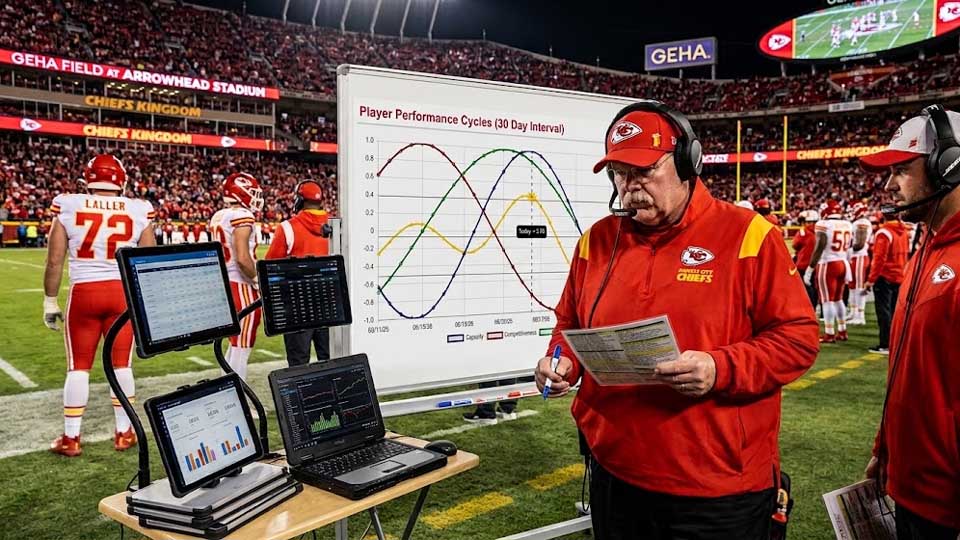
Let the Best Game-Day Projections Build Your NFL DFS Lineup
There are dozens of ways to construct an NFL DFS lineup.
You can stack quarterbacks with receivers.
You can chase high-scoring games.
You can build around elite running backs.
You can search for inexpensive value plays.
You can fade popular players.
You can build conservatively for cash contests or aggressively for tournaments.
But before using any of those strategies, there is a much simpler question worth asking:
What happens if we let the TriSync Projection lead the way?
That is the foundation of the TriSync Projection Strategy.
Instead of beginning with a favorite player, a particular NFL team or even a traditional DFS theory, begin with each player's, TriSync Projection and examine who is expected to perform best in the upcoming game.
Then use the TriSync Value Projection and Lineup Signal to determine which players offer the most attractive DFS opportunities within the salary cap.
It is the most direct way to use the core predictive measurements on TriSync Sports.
And for NFL DFS, the timing is perfect.
Unlike a year-long fantasy draft, where a player's long-term Overall Average is extremely important, DFS is about one game.
One Sunday.
One scoring period.
That makes the TriSync Projection the key starting point.
What Is the TriSync Projection?
The TriSync Projection is designed to estimate a player's expected performance level for a specific game.
It combines the player's typical production with his historical results in his current TriSync performance window conditions.
Those conditions fall into four performance windows:
Excellent
Good
Fair
Suboptimal
The Projection takes those performance patterns and turns them into one number that can be compared across players.
The basic rule is simple:
The higher the TriSync Projection, the stronger the expected performance.
That does not mean blindly selecting the players with the highest numbers on the page.
NFL DFS has positions.
It has salaries.
It has roster restrictions.
And it has a $50,000 salary cap.
The challenge is finding the strongest combination of projected performance and DFS value that fits all of those requirements.
That's where the strategy begins.
The DraftKings Classic Lineup
For this strategy, we're using the standard DraftKings NFL Classic format.
The lineup consists of:
1 QB
2 RB
3 WR
1 TE
1 FLEX — RB, WR or TE
1 D/ST
You have $50,000 to spend.
That means every decision involves more than simply finding the player with the highest TriSync Projection.
We also need to know:
What are we getting for the salary we're spending?
That's where the TriSync DFS analysis becomes particularly valuable.
Why This Strategy Is Different
Most DFS players begin with conventional information.
Recent fantasy points.
Matchups.
Vegas totals.
Projected ownership.
Target share.
Touch volume.
All of those can be useful.
But much of that information is also widely available.
Your opponents are looking at it too.
TriSync approaches the problem from a different direction.
Instead of simply asking:
What has this player been doing?
we are also asking:
How has this player historically performed when his current performance cycles look like this?
That creates another layer of information.
The TriSync Projection brings that information together into a game-specific rating.
Then the TriSync DFS system goes another step by evaluating that expected performance from a daily fantasy perspective.
For this strategy, we're going to put those measurements at the center of the lineup-building process.
Week 2 Is a Perfect Example
The second week is one of the most interesting DFS slates of the NFL season.
Why?
Because everybody thinks they know what is going to happen.
Fantasy rankings have been studied for months, and each team has only played one game.
Depth charts have been analyzed.
Draft positions have still created expectations.
Preseason hype and Week 1 results have pushed certain players up the board.
That means a lot of DFS decisions are still being driven by expectations.
TriSync gives us another perspective.
For Week 2, we can examine each player's current TriSync Projection before the season has had a chance to create new hot streaks, cold streaks and public narratives for the current season.
That makes it an excellent test of the strategy.
Step 1: Start With the TriSync Projection
The first step is simple.
Go to the NFL Player Projections page, which will reflect the Week 2 scoring period, and filter on All Offense.
Then examine the players by TriSync Projection.
Do not worry about building the lineup yet.
First, look at the board.
Which quarterbacks stand out?
Which running backs?
Which wide receivers?
Which tight ends?
Where does the projection quality begin to drop?
This introduces an important DFS concept:
Projection Tiers
Not every difference matters equally.
Suppose one group of players has projections clustered between 5.80 and 6.10.
Then the next group drops into the mid-4s.
That separation matters.
You may want to pay for a player from the stronger tier rather than accepting a significant drop in expected performance.
But what if two players have nearly identical TriSync Projections and one is substantially less expensive?
Now we need another measurement.
That's where the TriSync Value Projection comes in.
Step 2: Let the TriSync Value Projection Do the Salary Analysis
Finding a player with a strong TriSync Projection is only part of the DFS equation.
You also have to determine whether you're getting enough expected production for the salary you're paying.
That's where the TriSync Value Projection becomes important.
TriSync Sports takes the analysis beyond simply listing a player's game-day Projection.
The DFS report evaluates the player's expected performance from a DFS value perspective and produces a TriSync Value Projection designed specifically to help with lineup construction.
That means you don't have to look at two players and manually ask:
“Is giving up a small amount of TriSync Projection worth saving $2,000?”
The TriSync Value Projection is designed to help identify those opportunities.
And TriSync goes one step further.
The underlying analysis is translated into an easy-to-understand:
Lineup Signal
Depending upon the player's projection, value and overall DFS situation, you may see classifications such as:
Value + - The player is at a level where he historically performs better than usual.
Value - The player has a good chance to outperform his salary level.
Core - A player projected to score at an elite level and can be keyed in multiple lineups.
Premium - A player that is expected to achieve a high points total.
Secondary - A player that should earn a solid amount of points.
Filler - The player should score an acceptable amount of points for his salary level.
Punt - A player that is worth using when looking to fit within the salary cap.
Trap - A player that could possibly perform at a lower value than his expected salary.
Battle - The starting quarterback is evenly matched up with the opposing defense.
Tough D - The starting quarterback is likely to have a tough matchup against the opposing defense.
Low Output - The player is not expected to perform well as far as scoring points.
Avoid - The player is at a Suboptimal level and expected to underperform.
Incomplete - A player with a limited amount of data in the current year.
These designations provide another layer of information when constructing the lineup.
A Value+ or Value player may provide the salary efficiency needed to afford a premium player somewhere else.
A Core player represents exactly the type of foundation around which a lineup, even multiple lineups, can be constructed.
A Premium player may carry a higher salary, but still justify the investment because of his expected production.
A Secondary option may become useful when the preferred players don't fit the salary structure.
And Filler or Punt options can occasionally provide the inexpensive piece needed to complete a lineup, although those selections naturally require greater caution.
A Trap designation highlights a player that you may still decide to use, but be aware that you may be over-paying for his production level.
Players classified as Battle, Tough D or Low Output deserve additional scrutiny before being placed into a lineup, but most of the time they are just not used. The Battle and Tough D labels are for expected starting quarterbacks that are facing a defensive battle, or an extremely tough, primed defense. Low Output just means there doesn’t appear to be enough positive production from the player to be used in a DFS lineup.
An Avoid designation tells you that the player is in a Suboptimal window, and his TriSync Projection puts him well below his standard output.
An Incomplete designation tells you that there isn't enough information available to make the same level of evaluation.
The important point is:
Price alone doesn't determine value.
A $4,000 player isn't automatically a bargain.
And an $8,000 player isn't automatically overpriced.
The question is:
What are we getting for the salary we're spending?
The TriSync Value Projection and Lineup Signal are designed to help answer that question.
TriSync Projection + TriSync Value Projection
These two measurements work together.
Think of them this way:
TriSync Projection asks:
How strongly is this player expected to perform in this game?
TriSync Value Projection asks:
How attractive is that expected performance from a DFS value perspective?
That's an important distinction.
A player can have an outstanding TriSync Projection without necessarily being the best salary value.
Likewise, a moderately projected player may become extremely interesting if his salary creates exceptional lineup flexibility.
For example, imagine two running backs.
Running Back A
Salary: $8,100
TriSync Projection: 6.15
Lineup Signal: Premium
Running Back B
Salary: $5,600
TriSync Projection: 5.80
Lineup Signal: Value+
Running Back A still has the stronger raw Projection.
But Running Back B may provide considerably greater lineup flexibility.
That $2,500 savings could allow you to upgrade a WR, TE or FLEX position.
Which player belongs in the lineup?
There isn't automatically one correct answer.
That's why we want both measurements.
TriSync Projection helps identify expected performance.
TriSync Value Projection helps identify DFS opportunity.
The strongest lineup will often contain a mixture of both.
Step 3: Build Around Core, Premium and Value
One simple way to use the TriSync DFS information is to think of your lineup in layers.
Start by looking for Core players.
These are players whose overall DFS profile makes them particularly attractive building blocks.
Next, identify the Premium players.
You probably won't be able to afford all of them.
That's okay.
Determine which premium options provide the greatest advantage at their positions.
Then find the Value+ and Value players who allow you to afford them.
This creates a natural lineup-building process:
Core establishes the foundation.
Premium provides the firepower.
Value+ and Value create the salary flexibility.
(Some weeks, the flow goes better if the Value+ and Value are the first consideration, then Core, then Premium, then Secondary. As you use TriSync more and more, you will figure out what works for you.)
The remaining categories help complete the puzzle.
You don't want every player in your lineup to carry the same designation.
In fact, salary restrictions make that virtually impossible.
The goal is finding the best combination.
Step 4: Start Building With Quarterback
Quarterback is an excellent place to begin because you only need one.
For Week 2, identify the quarterbacks with the strongest TriSync Projections.
Then compare their DFS information.
Look at:
Lineup Signal
Player Profile / Output Level
Projected scoring range
Salary
Week 2 QB Candidates (for Sunday games, Sunday night game excluded)
Jalen Hurts — $6700 — TriSync Projection: 5.50 — TriSync Value Projection: 2.58 — Premium — Variable/Fair
Drake Maye — $6100 — TriSync Projection: 5.49 — TriSync Value Projection: 2.98 — Premium — Aligned/Good
Jacoby Brissett — $5000 — TriSync Projection: 5.41 — TriSync Value Projection: 3.10 — Secondary — Developing/Suboptimal
Brock Purdy — $6200 — TriSync Projection: 5.37 — TriSync Value Projection: 2.59 — Premium — Variable/Fair
The goal is not automatically to take the highest projected QB.
We're looking for the quarterback who gives us the best combination of expected production and DFS value while preserving enough salary to build the rest of the lineup.
This was an unusual week as only one quarterback, Josh Allen, had a Core Lineup Signal. (He did have a big night on Thursday, as expected by TriSync.)
(For all of the examples, the Variance is toggled to the Hi setting for the TriSync Value Projection. Typically, the Lo setting is better for cash games, and the Hi setting for larger size tournaments.)
Step 5: Running Back Is About Projection Plus Opportunity
Running backs deserve special attention.
A strong TriSync Projection becomes especially attractive when combined with a large expected workload.
Carries.
Receptions.
Goal-line opportunities.
Those create multiple paths toward DFS scoring.
Identify the Week 2 running backs with the strongest TriSync Projections.
Then examine their TriSync Value Projections and Lineup Signals.
Week 2 RB Candidates
Bijan Robinson — $8200 — TriSync Projection: 6.51 — TriSync Value Projection: 2.81 — Core — Aligned/Good
Javonte Williams — $6400 — TriSync Projection: 6.08 — TriSync Value Projection: 3.11 — Core — Aligned/Excellent
Christian McCaffrey — $8000 — TriSync Projection: 5.86 — TriSync Value Projection: 2.46 — Core — Variable/Fair
De'Von Achane — $6700 — TriSync Projection: 5.75 — TriSync Value Projection: 2.68 — Core — Aligned/Good
You need at least two.
Potentially three if one fills the FLEX spot.
This is where salary allocation becomes critical.
A Premium RB may be worth paying for.
But combining him with a Value+ running back may allow you to spend more aggressively at wide receiver.
Let the TriSync DFS analysis help determine the combination.
Step 6: Wide Receiver Is Where the Puzzle Gets Interesting
You need three wide receivers.
Possibly four if you use a WR at FLEX.
That means receiver value can determine whether the entire lineup works.
Begin with the strongest TriSync Projections.
Then look at the Value Projection and Lineup Signal.
Week 2 WR Candidates
Drake London — $6000 — TriSync Projection: 5.95 — TriSync Value Projection: 3.06 — Core — Aligned/Good
Jaxon Smith-Njigba — $8100 — TriSync Projection: 5.92 — TriSync Value Projection: 2.38 — Core — Aligned/Fair
Chris Olave — $7200 — TriSync Projection: 5.52 — TriSync Value Projection: 2.34 — Core — Aligned/Good
Ja'Marr Chase — $7600 — TriSync Projection: 5.24 — TriSync Value Projection: 2.18 — Core — Aligned/Fair
Christian Watson — $6200 — TriSync Projection: 5.15 — TriSync Value Projection: 2.12 — Core — Aligned/Fair
This is also where TriSync may identify players the general DFS market doesn't prioritize.
A famous receiver with a huge salary may attract plenty of attention because of reputation.
But another receiver could carry a competitive TriSync Projection and a much stronger TriSync Value Projection at a lower salary.
That's exactly the type of difference we're searching for.
Step 7: Tight End Can Unlock the Lineup
Tight end frequently provides an opportunity to save salary.
The highest-priced player isn't always necessary.
If an inexpensive TE carries a competitive TriSync Projection and an attractive Lineup Signal, the savings can be used to upgrade RB or WR.
Week 2 TE Candidates
Trey McBride — $6900 — TriSync Projection: 5.65 — TriSync Value Projection: 2.67 — Core — Aligned/Good
George Kittle — $4600 — TriSync Projection: 4.49 — TriSync Value Projection: 2.30 — Core — Aligned/Good
Dallas Goedert — $4800 — TriSync Projection: 4.06 — TriSync Value Projection: 1.77 — Premium — Aligned/Good
This is one position where the difference between projections matters more than the raw ranking.
If the top tight end projects substantially better than everyone else, paying for the Premium option may be worthwhile.
If several TEs project similarly, a Value, Value+, or Secondary alternative could unlock the rest of the lineup.
Step 8: Use FLEX to Maximize the Lineup
Do not automatically decide that FLEX must be a running back or receiver.
Let the board decide.
After you've selected:
2 RB
3 WR
1 TE
look at every remaining RB, WR and TE.
Which player offers the strongest combination of:
TriSync Projection
TriSync Value Projection
Lineup Signal
and
affordable salary?
That player becomes the FLEX candidate.
This is one of the easiest places for traditional lineup habits to hurt you.
Someone may automatically use an RB because they prefer RB volume.
Another manager may automatically use a WR.
The TriSync Projection Strategy starts from a different place.
Which remaining player gives this lineup the strongest overall DFS opportunity?
That's the question.
Step 9: Selecting D/ST: TriSync Value Projection and Budget are Key
The Defense/Special Teams (D/ST) is typically left as the final piece to the puzzle.
The NFL Team Projections page is the place to find your D/ST.
Usually, you are just going to pick the D/ST with the highest TriSync Value Projection, that has a salary that still fits within your budget:
New York Jets — $2400 — TriSync Projection DST: 3.38 — TriSync Value Projection: 1.37
Jacksonville Jaguars — $2400 — TriSync Projection DST: 2.93 — TriSync Value Projection: 1.13
Seattle Seahawks — $3500 — TriSync Projection DST: 3.12 — TriSync Value Projection: 1.12
When selecting which team to put in the D/ST slot, the TriSync Value Projection is the key metric to consider, with the TriSync Projection DST used as a tie-breaker for close calls. The Value Projection is more important, due to the nature of DFS scoring and of statistics such as points allowed and yards allowed, which are accounted for as a team, not on an individual basis.
In DFS, Defense/Special Teams doesn’t necessarily reward the best defense, it rewards the team that makes the biggest impact plays. Also, the salary tends to vary widely from week to week, based on the offensive matchup.
The Week 2 TriSync Projection Lineup
Here is the structure we want to build. This is just one possibility out of very many, on how to decipher the information, keying the TriSync Projection.
QB
Salary: $6100
TriSync Projection: 5.49
TriSync Value Projection: 2.98
Lineup Signal: Premium
Profile/Output Level: Aligned/Good
RB1
Salary: $8200
TriSync Projection: 6.51
TriSync Value Projection: 2.81
Lineup Signal: Core
Profile/Output Level: Aligned/Good
RB2
Salary: $6400
TriSync Projection: 6.08
TriSync Value Projection: 3.11
Lineup Signal: Core
Profile/Output Level: Aligned/Excellent
WR1
Salary: $8100
TriSync Projection: 5.92
TriSync Value Projection: 2.38
Lineup Signal: Core
Profile/Output Level: Aligned/Fair
WR2
Salary: $7200
TriSync Projection: 5.52
TriSync Value Projection: 2.34
Lineup Signal: Core
Profile/Output Level: Aligned/Good
WR3
Salary: $3100
TriSync Projection: 4.07
TriSync Value Projection: 2.51
Lineup Signal: Filler
Profile/Output Level: Developing/Fair
TE
Salary: $4400
TriSync Projection: 3.48
TriSync Value Projection: 1.22
Lineup Signal: Value+
Profile/Output Level: Variable/Good
FLEX
Salary: $4100
TriSync Projection: 3.56
TriSync Value Projection: 1.02
Lineup Signal: Secondary
Profile/Output Level: Aligned/Fair
D/ST
Salary: $2,400
TriSync Projection DST: 3.38
TriSync Value Projection: 1.37
Total Salary: $50,000
Salary Remaining: $0
Don't Spend the Entire Salary Cap Just Because You Can
This deserves its own section.
Many DFS players feel uncomfortable leaving salary unused.
They shouldn't.
The goal isn't:
Spend exactly $50,000.
The goal is:
Build the strongest lineup.
Suppose your preferred TriSync lineup costs $49,600.
There is no reason to replace a strongly rated player simply because another player costs $400 more.
Salary is a restriction.
It is not a scoring category.
DraftKings does not award bonus points because you used every dollar.
If the TriSync information supports the cheaper combination, keep it.
Aligned Players Deserve Extra Attention
The TriSync Projection is even more useful when combined with player profile.
An Aligned player has historically performed more consistently with his underlying performance cycles.
That means a strong TriSync Projection from an Aligned player can carry additional confidence.
Imagine two similarly priced WRs:
Receiver A
TriSync Projection: 5.90
Profile: Aligned
Receiver B
TriSync Projection: 5.82
Profile: Variable
The projections are close.
Receiver A's Aligned profile can become the tiebreaker.
But don't take this too far.
A Variable player with a 6.30 Projection should not automatically be passed over for an Aligned player at 5.00.
Projection still matters.
Profile tells us how much additional confidence we may want to place behind it.
Excellent and Good Windows Should Command Attention
When constructing a TriSync-focused DFS lineup, pay particular attention to players currently sitting in:
Excellent
and
Good
performance windows.
These are the players operating in stronger cycle conditions.
An Aligned player in an Excellent window with a high TriSync Projection should immediately command attention.
But don't select players simply because the word Excellent appears next to their name.
The Projection already incorporates the player's actual fantasy ability.
A mediocre player in an Excellent window does not automatically become more desirable than an elite player carrying a much stronger Projection.
The Projection brings those pieces together.
That's why it remains our primary game-day number.
Don't Pay for a Name
NFL DFS salaries are influenced heavily by player quality and expectations.
But salary doesn't guarantee production.
Neither does reputation.
Suppose a superstar WR carries one of the highest salaries on the slate but has an ordinary TriSync Projection and mediocre DFS value.
Another receiver costs considerably less, carries a competitive Projection and receives a Value+ Lineup Signal.
The cheaper player deserves serious consideration.
The salary savings could upgrade:
A running back.
Your second receiver.
Your tight end.
Your FLEX.
Or several positions at once.
This is one of the biggest advantages of TriSync lineup construction.
It removes some of the emotional attachment to famous names.
You're paying for expected opportunity.
Not jerseys.
Don't Calculate Value Yourself When TriSync Already Has
This is an important part of the strategy.
You don't need to manually divide a player's TriSync Projection by his salary.
You don't need to invent your own salary multiplier.
And you don't need to assume that the cheapest player with a decent Projection is automatically the best value.
The DFS report is designed to perform a more sophisticated evaluation.
Use the information TriSync provides:
TriSync Projection
TriSync Value Projection
Lineup Signal
Player Profile / Output Level
Projected scoring range
Salary
Together, those measurements provide a much more complete picture than a simple projection-to-salary ratio.
The goal isn't to find the cheapest lineup.
It isn't to find the most expensive lineup.
And it isn't even to find the eight offensive players with the highest raw TriSync Projections.
The goal is to find the combination that provides the strongest overall DFS opportunity within the salary cap.
That's what the TriSync Projection Strategy is really about.
Start With Projection, Then Apply Football Logic
The TriSync Projection should lead the strategy.
It should not eliminate common sense.
After identifying the strongest candidates, check basic football circumstances.
Is the player expected to start?
Is he healthy?
Has his role changed?
Is a running back suddenly part of a committee?
Is a receiver dealing with a quarterback change?
Has an injury created additional opportunity for another player?
The Projection is our starting point.
Current NFL information confirms that the opportunity still exists.
This becomes especially important close to kickoff.
Cash Games vs. Tournaments
The basic strategy can work in both contest types.
But the way you interpret the board can change.
Cash Games
Leave the Variance toggle on Low.
In cash contests, prioritize strong projections and dependable opportunities.
You don't need nine miracle outcomes.
You need enough players to perform close to expectation.
Strong Aligned profiles can become particularly attractive.
Core, Premium, Value+ and Value Lineup Signals can help identify the pieces around which to construct the lineup.
GPP Tournaments
Set the Variance toggle to Hi.
In tournaments, ceiling becomes more important.
You can still begin with TriSync Projection, but you may eventually combine the strategy with:
QB stacking
Game stacking
Lower ownership
Higher-variance players
Contrarian construction
That leads to an important point:
The TriSync Projection Strategy does not have to operate alone.
It can become the foundation underneath several other DFS strategies.
The Projection Strategy + QB Stack
Suppose one of the highest-rated quarterbacks on the slate also has a receiver with a strong TriSync Projection.
Now you've got something interesting.
The quarterback's passing touchdowns can generate fantasy points for both players simultaneously.
Instead of abandoning the Projection Strategy to create a stack, you're finding a stack inside the strongest TriSync opportunities.
That's much more appealing.
The Projection Strategy + Game Stack
The same idea can extend to the opponent.
Suppose your QB and WR both carry strong projections.
An opposing WR also ranks highly.
Now you may be able to build:
QB + WR + opposing WR
while still staying true to the TriSync board.
If the game becomes high-scoring, those players can feed each other's fantasy ceiling.
Again:
Use TriSync to find the players first.
Then look for correlation.
The Projection Strategy + Marquee & Marginal
This combination can be particularly effective.
The Marquee & Marginal Strategy deliberately pays premium salaries for several elite players, then searches for inexpensive options capable of keeping the lineup under the salary cap.
The TriSync DFS information can make that process much more disciplined.
First, identify the Marquee players.
Look for elite fantasy performers carrying strong TriSync Projections and favorable Lineup Signals (Core or Premium).
Then search the lower salary ranges for the Marginal pieces.
But Marginal does not mean bad.
It simply means we're spending less at that roster position so we can spend more somewhere else.
Ideally, those inexpensive selections will carry a Value+, Value, or otherwise fall into a Filler or Punt designation.
That is exactly what we're looking for.
Instead of selecting a cheap player simply because we need the salary relief, we're looking for a lower-cost player whose TriSync analysis gives us a reason to believe the savings are justified.
That makes the combination much more strategic:
Pay for the Marquee players when the Projection justifies it.
Find the Marginal salary pieces where the Value Projection supports them.
Then let the $50,000 salary cap determine the best combination.
The Projection Strategy + Contrarian Play
This may eventually become one of the most valuable combinations.
Imagine two similarly priced receivers.
The popular player is expected to be heavily owned.
The second player carries an equally strong or better TriSync Projection but is expected to attract far less attention.
In a tournament?
That's interesting.
You aren't fading the popular player just to be different.
You're taking a lower-owned player because TriSync gives you a performance-based reason to believe he can compete with the popular choice.
That's intelligent leverage.
Don't Force Every Highest Projection Into One Lineup
This is another important mistake to avoid.
Suppose the three highest projections belong to expensive running backs.
You only need two RB slots and one FLEX.
Trying to force all three into the lineup may destroy the rest of the roster.
You might end up with three extremely weak receivers.
That's not the objective.
We want the strongest total lineup, not the greatest number of top-ranked individual players.
Every salary decision affects another position.
Think about the lineup as one connected puzzle.
Let the Lineup Signals Work Together
One of the advantages of the TriSync DFS system is that you don't need nine players who all fit the same description.
A successful lineup might contain:
2 Core players
2 Premium players
2 Value+ players
1 Value player
1 Secondary player
plus your D/ST.
Another slate might produce a completely different combination.
That's okay.
The Lineup Signals aren't telling you that every Value+ player must be selected or every Secondary player must be ignored.
They are providing context.
Think of them as pieces of the lineup-building language.
Core can identify foundations and players to use in multiple lineups.
Premium can identify players worth paying for.
Value+ and Value can identify salary opportunities.
Secondary can identify solid alternatives.
Filler and Punt can identify lower-cost possibilities when salary becomes tight.
Tough Spot and Low Output provide warnings, to examine football circumstances closely.
Incomplete tells you more information may be needed.
Put the pieces together.
The Final TriSync Projection Checklist
Before submitting a lineup, ask:
1. Have I compared every position by TriSync Projection?
Start with the core game-day number.
2. Have I checked the TriSync Value Projection?
Expected performance and DFS value aren't exactly the same thing.
3. What does the player's Lineup Signal tell me?
Core? Premium? Value+? Value? Secondary?
Use the additional context.
4. Am I paying too much for only a small Projection advantage?
Don't spend salary simply because you have it.
5. Did I identify Value+ and Value players capable of creating salary flexibility?
Those players can unlock Premium options elsewhere.
6. Are my strongest Aligned players receiving proper consideration?
Profile can increase confidence.
7. Am I forcing an Excellent player whose actual Projection isn't strong enough?
The Projection outranks the performance-window label.
8. Have I checked current NFL roles and injuries?
Projection needs opportunity.
9. Is my FLEX truly the best remaining RB/WR/TE combination?
Don't lock yourself into one position.
10. Have I preserved the D/ST allocation (typically $2300 to $3000)?
For this roster example, Jets are the best play for $2400.
11. Am I under $50,000?
You don't have to use every dollar.
12. Does the lineup make sense as a whole?
Don't destroy several positions just to obtain one superstar.
Why This Strategy Fits TriSync So Well
Many DFS strategies begin with a theory.
Stack this team.
Pay down at that position.
Fade this popular player.
The TriSync Projection Strategy begins with information.
It asks:
Which players does the TriSync model expect to perform best today?
Then the TriSync Value Projection adds another question:
Which of those opportunities make the most sense from a DFS value perspective?
And the Lineup Signal helps translate that analysis into lineup-building language.
Now we're not simply deciding what kind of lineup we want and searching for statistics to justify it.
We're allowing the TriSync information to show us where the opportunities are.
Some weeks that may lead toward Core running backs.
Another week may reveal tremendous Value+ opportunities at wide receiver.
Another may point toward an inexpensive quarterback, at his peak.
Another could make paying Premium salary at tight end worthwhile.
That's the beauty of the strategy.
It changes with the slate.
Conclusion: Let TriSync Lead the Lineup
NFL DFS creates thousands of possible lineup combinations.
You can spend hours trying to determine which one is perfect.
It probably doesn't exist.
The better goal is to create a repeatable process.
With the TriSync Projection Strategy, that process begins with expected game-day performance.
Start with the:
TriSync Projection.
Then evaluate DFS value through the:
TriSync Value Projection.
Use the:
Lineup Signal
to help identify Core, Premium, Value+, Value and other lineup possibilities.
Then consider:
Player Profile / Output Level
Projected scoring range
Salary
and
Current football circumstances.
Our job is not simply to buy the nine highest projections that fit.
It's to find the combination that gives us the strongest overall DFS opportunity for that $50,000.
That may mean paying for a Premium player.
It may mean building around a Core player.
It may mean finding the Value+ selection that suddenly makes the entire lineup work.
And it may mean combining this strategy with QB stacking, game stacking, Marquee & Marginal or contrarian concepts.
That's what makes TriSync different.
We're not beginning with the biggest names.
We're beginning with the information.
TriSync can be the missing piece of the puzzle, to take your game to the next level.
Start with the Projection.
Find the Value.
Read the Signal.
Build the lineup.
That's the TriSync Sports Projection Strategy.
Bet responsibly. Past performance of any analytical system does not guarantee future results. TriSync Sports is intended as an informational and entertainment tool.