Sign up for free to continue browsing!
Sign in to your account
Don't have an account?
Sign up to unlock these benefits:
- Current ratings, projections and analysis
- Advanced reports and managerial tools
- Build and save roster of favorite players
Already have an account?
Reset your password
Ready to try again?
Check your email
Ready to try again?
Set a new password
Ready to try again?
Password updated
Email verified
Verification failed
Help Guide & Frequently Asked Questions
Terms / Abbreviations
Definitions of icons used on this site
- Hot Streak - 3 games in a row with exceptional game performance ratings.
- Cold Streak - 3 games in a row with subpar game performance ratings.
- Stolen Base Alert - Player had >= 3 steals in the last week.
- Strike Out Alert - Pitcher had >= 10 strike outs in last outing.
- Home Run Alert - Player hit a home run in last game.
- Save Alert - Pitcher earned a save in last appearance.
- Quarterback Alert - Player had >= 300 passing yards in the last game.
- Running Back Alert - Player had >= 100 rushing yards in the last game.
- Receiver Alert - Player had >= 100 receiving yards in the last game.
- Turnover Alert - Player had an interception in the last game.
- Turnover Alert - Player had a fumble recovery in the last game.
- Sack Alert - Player had a sack in the last game.
- Aligned - Historical performance correlates tightly and reliably with cycle positions.
- Variable - Performance doesn’t track consistently with cycle positions.
- Developing - Cycle-performance relationship is emerging and hasn’t fully stabilized.
- Start/Play - Recommended option for including in lineups.
- Possible/Consider - Could be considered, look closer at profile and stats.
- Sit/Fade - Not an optimal choice to use in lineups.
- N/A - Not applicable as a roster position.
Definitions of terms used on the player listing sections of this site
- TriSync Projection - This exclusive, proprietary indicator of performance predicts expected output based on typical statistical ability adjusted for ability at the output level.
- Start/Sit Signal - A designation offering insight into potential use in various fantasy league lineups.
- Player Profile - Indicates the correlation between cycle convergence and actual game performance.
- Output Level - Predicted current level of performance, either Excellent, Good, Fair or Suboptimal.
- Overall Avg - Summarizes game performance metrics for an extended time period, typically the last year.
- Recent Avg - Summarizes game performance metrics for a recent time period, typically the last few weeks.
Definitions of lines on player profile performance cycle graphs
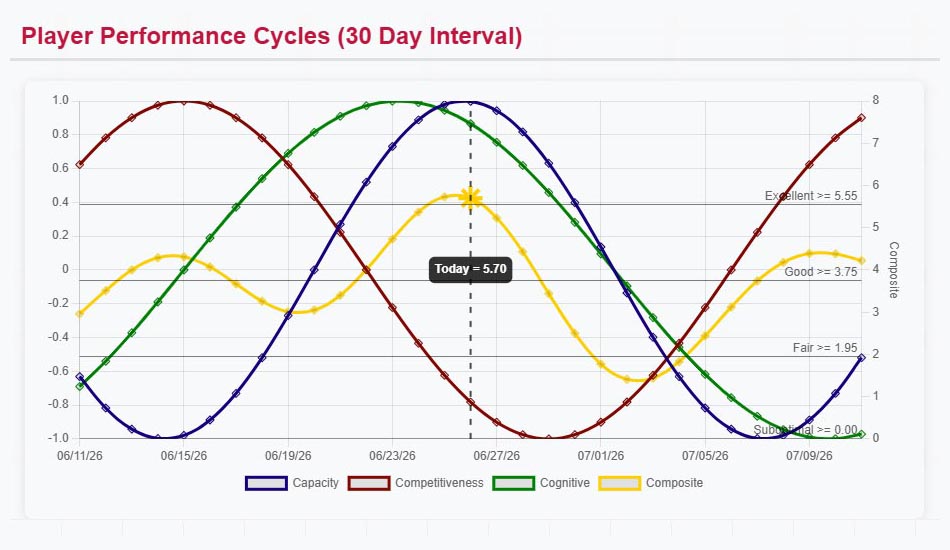
- Capacity Score - Tracks strength, stamina, coordination and overall physical capacity.
- Competitiveness Score - Tracks awareness, state of mind and emotional temperament.
- Cognitive Score - Tracks alertness, critical thinking and decision-making abilities.
- Composite Score - Reflects overall alignment & coordination of the individual cycles.
- Date Marker - Applicable date marker for specific game date, day or week.
Definitions of terms used on the player profile sections of this site
- TriSync Projection - Predicted output based on typical statistical ability adjusted for results at the current level.
- Output Level - Predicted current level of performance, either Excellent, Good, Fair or Suboptimal.
- Game Rating - Comprehensive player performance score assigned to each game, calculated using actual stats.
- Game Rating x̄ - Player's average Game Rating across all games in the specific season.
- Game Rating +/- % - Percentage change in average Game Rating at the specific output level.
Definitions of start/sit signals used on the fantasy league sections of this site
- Stream - Player entering an advantageous performance window, high-potential short-term pick-up option.
- Top Tier - A superstar that is rarely off form, or a player primed for a peak performance.
- Mid Tier - A player expected to have a productive performance on that particular day.
- Low Tier - A player expected to have a decent performance on that particular day.
- Possible - A player to possibly use on that particular day after checking profile and statistics.
- Bench - A player to bench on that particular day due to historic performance level.
- Don't Roster - The player is not expected to perform well enough for fantasy league purposes.
- Incomplete - A player with a limited amount of data in the current year.
- N/A - Not applicable as a roster position.
Definitions of lineup signals used on the daily fantasy specific sections of this site
- Value + - The player is at a level where he historically performs better than usual.
- Value - The player has a good chance to outperform his salary level.
- Core - A player projected to score at an elite level and can be keyed in multiple lineups.
- Premium - A player that is expected to achieve a high points total.
- Secondary - A player that should earn a solid amount of points.
- Filler - The player should score an acceptable amount of points for his salary level.
- Punt - A player that is worth using when looking to fit within the salary cap.
- Trap - A player that could possibly perform at a lower value than his expected salary.
- Duel - The starting pitcher is evenly matched with the opposing starting pitcher.
- Risky Spot - The player is facing a strong starting pitcher and subject to a challenge.
- Tough Spot - The player is expected to encounter a battle with the opposing pitcher.
- Battle - The starting quarterback is evenly matched up with the opposing defense.
- Tough Spot - The starting quarterback is likely to have a tough matchup against the opposing defense.
- Low Output - The player is not expected to perform well as far as scoring points.
- Avoid - The player is at a Suboptimal level and expected to underperform.
- Incomplete - A player with a limited amount of data in the current year.
Frequently Asked Questions - General
What is TriSync Sports all about?
TriSync Sports is a performance analytics platform that uses cycle analysis to predict when athletes are most likely to perform at their peak. Our system tracks the three core cycles of capacity, competitiveness and cognition to generate daily performance forecasts for MLB, NFL, NBA & NHL players.
Who is TriSync Sports designed for?
Our platform is primarily intended to serve these groups:
- Rotisserie fantasy managers optimizing routine start/sit decisions
- Daily fantasy sports players looking for edges constructing lineups
- Sports wagerers focused on a variety of player prop bets
- Sports fans who want deeper insight into player performance trends
What makes TriSync Sports different?
Unlike traditional stat projections, we analyze underlying performance cycles that affect when players are naturally primed for peak performance. This gives an edge by identifying high-performance windows before they're reflected in recent statistics or betting lines. It provides highly valuable information to supplement typical data and tools available.
How accurate are your predictions?
Our predictions show a strong correlation between cycle convergence and actual game performance. We continuously track and display historical accuracy data for each player and performance level. Our system has been refined over 40+ years of research and real-world application.
How often are ratings and projections updated?
Player performance forecasts are updated daily. Up-to-date game results are used to continuously refine our correlation models to improve accuracy.
How is actual game performance measured?
Our comparative game performance ratings reflect how players truly performed in completed games, using sport-specific scoring metrics.
Does TriSync Sports provide gambling advice?
No. This site only provides analytical insights. All wagering decisions are strictly your responsibility.
Does TriSync Sports offer free trials?
Yes! Anyone can access the platform to browse all current players for a particular sport, view individual player profiles and preview premium content without creating an account. Subscribers will have full access to all proprietary TriSync ratings, forecasted data, advanced tools and reports.
What are subscription plan options and pricing?
Paid subscriptions include all the data/tools necessary for serious players dedicated to winning.
- Free $0.00/month - Limited access to MLB sections of the site
- Basic $5.95/month - All free features, plus full access to ROTO dashboard
- Premium $9.95/month - All basic features, plus full access to DFS & STATS dashboards
Frequently Asked Questions - MLB
How do performance cycles apply to baseball?
Baseball is ideal for cycle analysis because of the daily game schedule, large number of games and individual player matchups. Pitchers show strong correlations on peak performance days, while hitters benefit from improved timing, pitch recognition, and mental focus during high-cycle periods.
How far in advance can I see MLB player predictions?
The main MLB projections listing always shows data for the current day, with options for viewing yesterday or tomorrow, for all active players. Once you access the individual player profile pages, cycle data is presented in 30 day intervals that forecast 15 days ahead, allowing you to plan daily fantasy lineups, identify streaming pitchers for rotisserie leagues, and spot value before odds adjust.
What is the performance cycle composite score and why is it important?
The platform's core output, the composite score reflects performance cycle alignment. Think of it as a readiness score that tells you how coordinated a player's Capacity, Competitiveness, and Cognitive cycles are on a given day. A player with a high score isn't just statistically capable of performing well, his mind, body and spirit are primed for it. Conversely, a player with a low score may carry an impressive stat resume, but cycles suggest a potential downturn.
What is the TriSync projection and how do I use it?
This proprietary daily indicator of performance predicts the expected output for a player based on typical statistical ability adjusted for results at the current level. The higher the rating, the better the player is predicted to perform on the particular day. Use this singular metric to compare players across all types of fantasy scenarios.
How do the start/sit signals help with my lineups?
The start/sit signal is a designation for each player that offers insight into his potential use in fantasy league lineups for the specific day. For definitions of all the possible designations please see the full help section.
- Play button (Green) - Recommended for including in lineup.
- Pause button (Yellow) - Possible use, dig deeper into profile and stats to decide.
- Stop button (Red) - Not advisable to include in lineup.
What do the different player profile types mean?
Each player has a profile designation which falls into one of three types:
Aligned - Historical performance correlates tightly and reliably with cycle positions. When an Aligned hitter carries a strong TriSync Projection, trust it with a high degree of confidence. Peak ratings are genuinely predictive of strong output and low ratings are equally predictive of poor performance.
Developing - Cycle-performance relationship is emerging but hasn’t fully stabilized. This most often applies to younger players who are still maturing physically or establishing consistent routines. TriSync Projections are directionally useful but carry more uncertainty.
Variable - Performance doesn’t track consistently with their cycle positions. Their cycle patterns are real, the Capacity, Competitiveness, and Cognitive rhythms are measurable, but the translation from cycle position to on-field production is noisy and unpredictable.
In general, a player with an Aligned profile type is more reliable than a player with a Variable player type. Players with a Developing profile type have limited experience so their statistics can be less reliable until they get enough games under their belt to generate an Aligned or Variable designation.
Aligned - Historical performance correlates tightly and reliably with cycle positions. When an Aligned hitter carries a strong TriSync Projection, trust it with a high degree of confidence. Peak ratings are genuinely predictive of strong output and low ratings are equally predictive of poor performance.
Developing - Cycle-performance relationship is emerging but hasn’t fully stabilized. This most often applies to younger players who are still maturing physically or establishing consistent routines. TriSync Projections are directionally useful but carry more uncertainty.
Variable - Performance doesn’t track consistently with their cycle positions. Their cycle patterns are real, the Capacity, Competitiveness, and Cognitive rhythms are measurable, but the translation from cycle position to on-field production is noisy and unpredictable.
In general, a player with an Aligned profile type is more reliable than a player with a Variable player type. Players with a Developing profile type have limited experience so their statistics can be less reliable until they get enough games under their belt to generate an Aligned or Variable designation.
How does the output level relate to the scores and ratings?
The daily composite score is directly converted into one of these four performance levels to indicate the strength of cycle convergence:
- Excellent - Peak performance level (Composite Score >= 5.55)
- Good - Strong performance level (Composite Score >= 3.75 & < 5.55)
- Fair - Average performance level (Composite Score >= 1.95 & < 3.75)
- Suboptimal - Poor performance level (Composite Score < 1.95)
What stats are used for measuring actual game performance?
We calculate a comprehensive Game Rating based on:
- Pitchers - Innings pitched, hits, earned runs, strikeouts, walks, wins & saves
- Hitters - Runs, hits, doubles, triples, home runs, RBI, stolen bases, walks & strikeouts
Does this work for playoffs and postseason?
Yes! Performance cycles continue regardless of season phase. In fact, the added pressure of playoff baseball can make the competitiveness & cognitive cycles even more impactful.
What about rookies or players with limited sample sizes?
Rookies are included once they debut, but we note limited data and designate them as developing a profile. Cycle theory suggests all humans follow these patterns, but correlation strength improves with larger performance samples. We display confidence indicators based on games played.
How can this impact my traditional fantasy baseball league?
For fantasy baseball with either weekly head-to-head matchups or rotisserie season-long formats with player drafts and points earned in various stat categories, use our system to:
- Make crucial daily lineup decisions, opting to start players with higher predictive performance ratings
- Optimize waiver pickups by looking at the forecast ahead for players entering peak performance windows
- Stream starting pitchers more efficiently based on favorable TriSync Projections on probable start days
- Bench players with aligned profiles that are showing suboptimal TriSync Projections on particular days
How does this help with daily fantasy baseball?
For daily fantasy sports (DFS), use our system to:
- Avoid expensive players projected to be in performance valleys
- Identify underpriced pitchers entering performance peaks
- Build contrarian lineups centered around cycle convergence that the general population isn't able to identify
- Stack hitters from the same team reaching peak cycles, especially versus a pitcher in a low performance window
Can this help when analyzing MLB player prop bets?
Absolutely! Player props are perfect for our system. When a player is in a peak performance window, they're more likely to exceed prop bet lines for the typical stat categories. Many bettors have found success focusing on players with favorable TriSync Projections.
Should I use the predictive ratings differently for pitchers and hitters?
Yes! For pitchers, high ratings correlate with better command, velocity, and decision-making which are imperative for strikeout totals and quality start predictions. For hitters, peak cycles align with improved bat speed, pitch recognition, and clutch performance which contribute to higher offensive category production. Also, looking to key particular hitters, sometimes up to as many as four in a lineup, that have peak cycles versus a pitcher projected to have a suboptimal performance is a strongly recommended strategy.
Frequently Asked Questions - NFL
How do performance cycles apply to football?
Football is well suited for cycle analysis because each game places a premium on preparation (including film study), physical readiness and especially, mental focus on game day. Quarterbacks can benefit from sharper decision-making and accuracy during Excellent, peak periods, while running backs, receivers and defensive players may experience improved timing, explosiveness, reaction and overall execution.
Does position matter more in football than other sports?
Yes, position-specific applications are crucial:
- QBs - Cognitive cycles affect reads and accuracy
- RBs - Capacity cycles impact power and stamina
- WRs/TEs - Competitiveness correlates with contested catches
- Kickers - Competitiveness & cognitive peaks align with clutch performance
Do performance cycles account for all the injuries in football?
Our cycles track optimal performance potential, not injury susceptibility. Always check injury reports before making decisions. However, players returning from injury during peak cycles often exceed expectations, while returns during low cycles may produce underwhelming efforts.
How far in advance can I see NFL player predictions?
The main NFL projections listing always shows data for the current week, with options for viewing last week or next week, for all active players. Once you access the individual player profile pages, cycle data is presented in 60 day intervals that forecast 30 days ahead, allowing you to plan daily fantasy lineups, identify streaming options for weekly leagues, and spot value before odds adjust.
How does weekly scheduling affect performance cycles?
Football's weekly schedule is perfect for cycle planning! Identify which players are entering peak windows for any games during that week well in advance. This gives you a significant edge in weekly DFS contests and survivor pools.
What is the performance cycle composite score and why is it important?
The platform's core output, the composite score reflects performance cycle alignment. Think of it as a readiness score that tells you how coordinated a player's Capacity, Competitiveness, and Cognitive cycles are on a given day. A player with a high score isn't just statistically capable of performing well, his mind, body and spirit are primed for it. Conversely, a player with a low score may carry an impressive stat resume, but cycles suggest a potential downturn.
What is the TriSync projection and how do I use it?
This proprietary daily indicator of performance predicts the expected output for a player based on typical statistical ability adjusted for results at the current level. The higher the rating, the better the player is predicted to perform on the particular day. Use this singular metric to compare players across all types of fantasy scenarios.
How do the start/sit signals help with my lineups?
The start/sit signal is a designation for each player that offers insight into his potential use in fantasy league lineups for the specific day. For definitions of all the possible designations please see the full help section.
- Play button (Green) - Recommended for including in lineup.
- Pause button (Yellow) - Possible use, dig deeper into profile and stats to decide.
- Stop button (Red) - Not advisable to include in lineup.
- X button (Gray) - Not applicable for using in lineup.
What do the different player profile types mean?
Each player has a profile designation which falls into one of three types:
Aligned - Historical performance correlates tightly and reliably with cycle positions. When an Aligned hitter carries a strong TriSync Projection, trust it with a high degree of confidence. Peak ratings are genuinely predictive of strong output and low ratings are equally predictive of poor performance.
Developing - Cycle-performance relationship is emerging but hasn’t fully stabilized. This most often applies to younger players who are still maturing physically or establishing consistent routines. TriSync Projections are directionally useful but carry more uncertainty.
Variable - Performance doesn’t track consistently with their cycle positions. Their cycle patterns are real, the Capacity, Competitiveness, and Cognitive rhythms are measurable, but the translation from cycle position to on-field production is noisy and unpredictable.
In general, a player with an Aligned profile type is more reliable than a player with a Variable player type. Players with a Developing profile type have limited experience so their statistics can be less reliable until they get enough games under their belt to generate an Aligned or Variable designation.
Aligned - Historical performance correlates tightly and reliably with cycle positions. When an Aligned hitter carries a strong TriSync Projection, trust it with a high degree of confidence. Peak ratings are genuinely predictive of strong output and low ratings are equally predictive of poor performance.
Developing - Cycle-performance relationship is emerging but hasn’t fully stabilized. This most often applies to younger players who are still maturing physically or establishing consistent routines. TriSync Projections are directionally useful but carry more uncertainty.
Variable - Performance doesn’t track consistently with their cycle positions. Their cycle patterns are real, the Capacity, Competitiveness, and Cognitive rhythms are measurable, but the translation from cycle position to on-field production is noisy and unpredictable.
In general, a player with an Aligned profile type is more reliable than a player with a Variable player type. Players with a Developing profile type have limited experience so their statistics can be less reliable until they get enough games under their belt to generate an Aligned or Variable designation.
How does the output level relate to the scores and ratings?
The daily composite score is directly converted into one of these four performance levels to indicate the strength of cycle convergence:
- Excellent - Peak performance level (Composite Score >= 5.55)
- Good - Strong performance level (Composite Score >= 3.75 & < 5.55)
- Fair - Average performance level (Composite Score >= 1.95 & < 3.75)
- Suboptimal - Poor performance level (Composite Score < 1.95)
What stats are used for measuring actual game performance?
We calculate a comprehensive Game Rating based on:
- Offense - Passing, rushing and receiving yards and touchdowns, receptions, interceptions, fumbles & return TDs
- Defense - Tackles, QB sacks, QB hits, passes tipped, interceptions, fumbles & return TDs
- Special Teams - Field goals made, extra points made, punts, punt yards, punt accuracy & return TDs
How might weather and field conditions get factored in?
Combine our cycle data with external weather analysis to take things to the next level! A Quarterback in a peak cognitive cycle throwing in a dome has even higher upside, while running backss in peak capacity cycles gain extra value in bad weather games.
Does this work for playoffs and postseason?
Yes! Performance cycles continue regardless of season phase. In fact, the added pressure of playoff football can make the competitiveness & cognitive cycles even more impactful.
Is this available for college football too?
Currently we only focus on the NFL due to data availability and sample size requirements, but the same principles apply to college players as well. However, we may expand the offerings in the future.
What about rookies or players with limited sample sizes?
Rookies are included once they debut, but we note limited data and designate them as developing a profile. Cycle theory suggests all humans follow these patterns, but correlation strength improves with larger performance samples. We display confidence indicators based on games played.
How can this impact my traditional fantasy football league?
For fantasy football with either weekly head-to-head matchups or season-long formats with player drafts and points earned in various stat categories, use our system to:
- Make confident start/sit decisions, opting to start players with higher predictive performance ratings
- Identify trade targets and stream waiver wire pickups entering extended peak performance periods
- Bench players with aligned profiles that are showing suboptimal TriSync Projections on particular days
How does this help with daily fantasy football?
For daily fantasy sports (DFS), use our system to:
- Avoid expensive players projected to be in performance valleys
- Identify underpriced players entering performance peaks
- Build contrarian lineups centered around cycle convergence that the general population isn't able to identify
- Stack offensive teammates reaching peak cycles, especially against a defense in a low performance window
Can this help when analyzing NFL player prop bets?
Absolutely! NFL props are ideal for cycle analysis:
- QB passing yards/TDs - Cognitive and competitiveness peaks boost decision-making
- RB rushing yards - Capacity peaks enhance endurance and power on the ground
- WR receptions - All three cycles converging improves separation and hands
- Defensive stats - Peak cycles for defenders can predict sack/interception performance
Should I use the predictive ratings differently for offense and defense?
Yes! For offense, the predictive ratings can help identify quarterbacks, running backs, receivers, tight ends, and other players whose current cycles suggest stronger or weaker performance potential. Looking for multiple key offensive players with favorable ratings can also help identify offenses positioned for stronger overall production.
For defense, the predictive ratings can help identify players whose cycles suggest stronger or weaker defensive performance, thus constricting the opponent's fantasy scoring. Comparing the offensive TriSync Projection with the opposing defensive TriSync Projection can provide another valuable layer of analysis. An offense featuring several players in peak cycles matched against a defense with weaker ratings can signal a particularly favorable matchup.
For defense, the predictive ratings can help identify players whose cycles suggest stronger or weaker defensive performance, thus constricting the opponent's fantasy scoring. Comparing the offensive TriSync Projection with the opposing defensive TriSync Projection can provide another valuable layer of analysis. An offense featuring several players in peak cycles matched against a defense with weaker ratings can signal a particularly favorable matchup.
Frequently Asked Questions - MLB DFS
How does TriSync Sports help with daily fantasy baseball?
For daily fantasy sports (DFS), use our system to:
- Avoid expensive players projected to be in performance valleys
- Identify underpriced pitchers entering performance peaks
- Build contrarian lineups centered around cycle convergence that the general population isn't able to identify
- Stack hitters from the same team reaching peak cycles, especially versus a pitcher in a low performance window
What is the TriSync Value Projection and why is it important?
The TriSync Value Projection is the main indicator of a player's daily fantasy worth for the day, with higher being better. It is determined by an algorithm using metrics such as player’s expected performance based on his cycle, general salary level and opposing pitcher. It can be used to find value when putting together daily fantasy lineups.
What is the difference between low and high variance for the data?
The user can toggle the Variance switch between Lo and Hi, altering the TriSync Value Projection and Lineup Signal to better reflect a player’s value in a typical cash game environment (low variance), or tournament format where bigger payoffs are at the top (high variance).
How do the signals help when constructing my daily fantasy lineups?
The lineup signal is a designation for each player that offers insight into his value and potential use in daily fantasy lineups for the specific day. For definitions of all the possible lineup signals please see the full help section.
- Play button (Green) - Recommended for including in lineups.
- Pause button (Yellow) - Possible play, dig deeper into profile and stats to decide.
- Stop button (Red) - Not advisable to include in lineups.
What are the points minimum and maximum?
Based on proprietary TriSync algorithms, these values are the projected floor and ceiling for daily fantasy player points earned for the specific day.
Where do the daily fantasy salary figures come from?
TriSync sports provides an estimated salary for daily fantasy purposes. The $ button is used to switch between a typical system that uses dollar figures in the thousands or one that uses much lower standard amounts.
Frequently Asked Questions - NFL DFS
How does TriSync Sports help with daily fantasy football?
For daily fantasy sports (DFS), use our system to:
- Avoid expensive players projected to be in performance valleys
- Identify underpriced players entering performance peaks
- Build contrarian lineups centered around cycle convergence that the general population isn't able to identify
- Stack offensive teammates reaching peak cycles, especially against a defense in a low performance window
What is the TriSync Value Projection and why is it important?
The TriSync Value Projection is the main indicator of a player's daily fantasy worth for the day, with higher being better. It is determined by an algorithm using metrics such as player’s expected performance based on his cycle, general salary level and opposing defense. It can be used to find value when putting together daily fantasy lineups.
What is the difference between low and high variance for the data?
The user can toggle the Variance switch between Lo and Hi, altering the TriSync Value Projection and Lineup Signal to better reflect a player’s value in a typical cash game environment (low variance), or tournament format where bigger payoffs are at the top (high variance).
How do the signals help when constructing my daily fantasy lineups?
The lineup signal is a designation for each player that offers insight into his value and potential use in daily fantasy lineups for the specific day. For definitions of all the possible lineup signals please see the full help section.
- Play button (Green) - Recommended for including in lineups.
- Pause button (Yellow) - Possible play, dig deeper into profile and stats to decide.
- Stop button (Red) - Not advisable to include in lineups.
- X button (Gray) - Not applicable for using in lineup.
What are the points minimum and maximum?
Based on proprietary TriSync algorithms, these values are the projected floor and ceiling for daily fantasy player points earned for the specific day.
Where do the daily fantasy salary figures come from?
TriSync sports provides an estimated salary for daily fantasy purposes. The $ button is used to switch between a typical system that uses dollar figures in the thousands or one that uses much lower standard amounts.