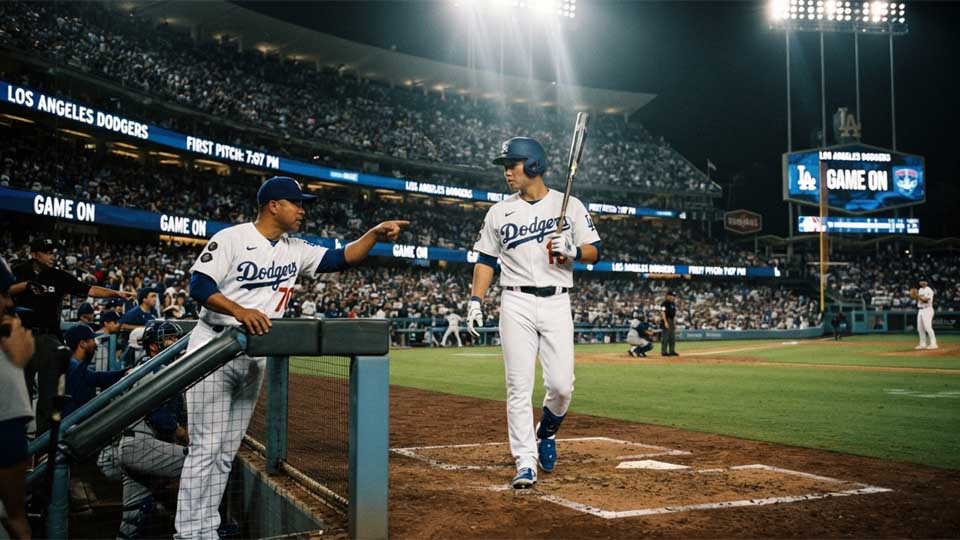
Using TriSync Sports With The Top-of-Order Strategy: Maximizing Plate Appearances for Consistent DFS Success
There's a fundamental truth in baseball that casual fans often overlook but DFS grinders live by: the best way to score fantasy points is to get more opportunities to score fantasy points.
Revolutionary, right?
Yet every slate, thousands of DFS players chase home run upside from cleanup hitters, stack the middle of lineups for RBI potential, or roster power bats in the 5-6-7 slots because they're "due" for a big game. Meanwhile, they're ignoring the mathematical advantage staring them in the face: leadoff and second-place hitters who are virtually guaranteed four or five plate appearances compared to two to three for guys hitting eighth.
The Top-of-Order Strategy isn't sexy. Nobody wins GPP tournaments and tweets "My leadoff hitter went 2-for-5 with a walk!" as their key to victory. But this approach, prioritizing batters who hit 1st, 2nd, or 3rd in their respective lineups, is the foundation of consistent DFS baseball success, particularly in cash games.
It's math, not magic. It's volume over variance. And when executed properly alongside other sound DFS principles, it's the difference between slowly building a bankroll and slowly bleeding one.
Let's break down exactly why lineup position matters so much, how to maximize this edge, and when to deviate from the top-of-order principle for other considerations.
The Mathematical Foundation: Why Plate Appearances Matter
The Basic Math
In a typical nine-inning baseball game, the batting order cycles roughly 3.8-4.2 times depending on offensive production and game pace.
Expected plate appearances by lineup position (nine-inning game):
- Leadoff (1st): 4.5-5.0 plate appearances
- Second (2nd): 4.3-4.8 plate appearances
- Third (3rd): 4.1-4.5 plate appearances
- Cleanup (4th): 3.9-4.3 plate appearances
- Fifth (5th): 3.7-4.1 plate appearances
- Sixth (6th): 3.5-3.9 plate appearances
- Seventh (7th): 3.2-3.6 plate appearances
- Eighth (8th): 3.0-3.4 plate appearances
- Ninth (9th): 2.8-3.2 plate appearances
The difference: On average, a leadoff hitter gets 1.3 more plate appearances than a seventh-place hitter.
Translating Plate Appearances to Fantasy Points
Average DFS scoring per plate appearance (rough estimates):
- Hit: 3 points
- Walk: 2 points
- Out: 0 points
- Extra-base hit: 5-8 points
- Home run: 10+ points
For an average hitter with .260 batting average and .330 OBP:
- 26% of PAs = hit (3 points)
- 7% of PAs = walk (2 points)
- 67% of PAs = out (0 points)
- Expected value per PA: ~0.92 points
Now apply the volume difference:
Leadoff hitter (5 PAs): 5 PAs × 0.92 points per PA = 4.6 expected points from volume alone
Seventh-place hitter (3.6 PAs): 3.6 PAs × 0.92 points per PA = 3.3 expected points from volume alone
The edge: 1.3 points per game just from batting position, before considering any difference in player quality.
Over eight hitters in your DFS lineup, if you prioritize top-of-order guys vs. bottom-of-order guys, you're gaining 8-10 points from plate appearance volume alone.
That's the difference between cashing and missing in a 50/50.
The Compounding Effect
The advantage multiplies when you consider:
1. Runners on base opportunities
Leadoff and second hitters create run-scoring opportunities for themselves and others:
- Leadoff hits = #2 or #3 hitter drives him in (RBI for them, run scored for leadoff)
- Second hitter doubles = cleanup hitter drives him in (RBI for cleanup, run scored for #2 hitter)
2. Stolen base opportunities
Top-of-order hitters, especially leadoff, get more chances to steal:
- More times on base = more steal opportunities
- On FanDuel especially (6 points per SB), this is massive value
3. Extra-inning potential
If a game goes to extras, the top of the order bats again first. Your leadoff hitter might get 6 PAs while your cleanup hitter stays at 5.
4. Blowout protection
In lopsided games, teams often cycle through the order 5+ times. Your leadoff hitter bats in the 9th even when the game is 12-3. Your seventh-place hitter might not.
When to Deploy the Top-of-Order Strategy
Primary Use Case: Cash Games
The strategy was made for 50/50s, Double-Ups, and Head-to-Heads.
Why it dominates cash:
1. Consistency over ceiling Cash games reward floor, not ceiling. Plate appearances provide the most consistent path to 8-12 points per hitter.
2. Reduced variance With 4-5 PAs, a leadoff hitter who goes 0-for-5 still likely drew a walk or scored a run (6-8 points). A cleanup hitter who goes 0-for-3 might have 0-2 points.
3. Bankroll stability Cashing 60% of cash games with top-of-order strategy > cashing 45% chasing power from bottom of order
Example cash game philosophy:
Instead of: "I need home runs from my cleanup hitters!"
Think: "I need my eight hitters to each deliver 8-12 points consistently."
Top-of-order batters deliver that floor more reliably than anyone else on the roster.
Secondary Use Case: Conservative GPP Approach
The strategy also works for single-entry GPPs or smaller tournaments where you're not swinging for maximum upside.
When to use in GPPs:
✅ Small-field tournaments (under 1,000 entries)
✅ Single-entry contests (one lineup, want solid floor)
✅ Beginner-focused GPPs (where field won't optimize as well)
✅ Satellite qualifiers (just need to min-cash, not win)
In these situations, the consistency of top-of-order hitters often outperforms the boom-or-bust nature of middle of the order power bats.
When NOT to Prioritize Top-of-Order
Large-field GPPs (5,000+ entries) with top-heavy payouts:
In massive tournaments, you need ceiling over floor. A leadoff hitter going 3-for-5 with two singles (14 points) is nice, but a cleanup hitter going 2-for-4 with two home runs (28 points) wins tournaments.
The adjustment:
- Still roster two or three top-of-order guys (for correlation and floor)
- But include three or four power bats from middle of order (4th-5th spots)
- Accept higher variance in exchange for tournament-winning ceiling
Extreme correlation situations:
If you're stacking five or six hitters from the same team, you need to include the cleanup and 5th hitter even though they don't maximize plate appearances. The correlation value outweighs the plate appearances advantage.
When Profile Types Are Important
Before we get into salary distribution and lineup construction, there is another TriSync concept to understand: the player profile classification.
Every player in the TriSync database is classified into one of three profile types based on how consistently their on-field performance tracks with their cycle positions over time:
Aligned profiles are players whose historical performance correlates tightly and reliably with their cycle positions. When an Aligned hitter carries a strong Composite score, you can trust that rating with a high degree of confidence. His peak ratings are genuinely predictive of strong output, and his Suboptimal ratings are equally predictive of poor performance. For a cash game strategy built entirely on floor and consistency, Aligned players are the foundation. Their Composite scores translate directly into predictable DFS production — which is exactly what you need to cross the cash line night after night.
Developing profiles are players whose cycle-performance relationship is emerging but hasn’t fully stabilized. This most often applies to younger players who are still maturing physically or establishing consistent routines. Their Composite scores are directionally useful but carry more uncertainty. Developing profile players can fill secondary roster spots, but they shouldn’t anchor your stack or occupy your highest-salary positions.
Variable profiles are players whose performance doesn’t track consistently with their cycle positions. Their cycle patterns are real — the Capacity, Competitiveness, and Cognitive rhythms are measurable — but the translation from cycle position to on-field production is noisy and unpredictable. A Variable hitter might go 3-for-4 during a Suboptimal window and 0-for-4 during a peak one.
The practical rules for cash games using this strategy: Anchor your lineups with Aligned profiles with a Composite score >= 3.75 . Use Developing profiles as secondary fills when the matchup is strong. Minimize or avoid Variable profiles, unless it is a Marquee batter with an Overall Rating of 4.20 or higher. A high production DFS points producer, with a Variable profile, can produce a strong result at any time.
The practical rules for tournaments (GPPs) using this strategy: Anchor your lineups with players with an Overall Rating of 4.20 or higher. Use batters with an Overall Rating of 4.19 to 4.00 as secondary fills. Maximize using players with an Aligned profile, and a Composite score of 5.55+. Avoid players with an Aligned profile, and a Composite score < 1.95.
Identifying Top-of-Order Value
The Obvious Leadoff Hitters
Characteristics of elite DFS leadoff hitters:
✅ Contact-oriented approach (.270+ batting average)
✅ High on-base skills (.340+ OBP)
✅ Speed element (15+ stolen bases projected)
✅ Consistent lineup position (bats leadoff 90%+ of games)
✅ Solid effort (Composite score >= 1.95, if an Aligned profile)
✅ Quality offense around them (good hitters behind them = more RBI opportunities for the team = more runs scored for leadoff)
Examples of prototypical DFS leadoff hitters:
- Shohei Ohtani (Dodgers): Contact, power, speed, guaranteed leadoff, Aligned, 4.46 Overall Rating
- Ronald Acuña Jr. (Braves): Leadoff, Aligned profile who performs even better when Composite score >= 3.75 (Good or Excellent performance window), 4.13 Overall Rating
- Steven Kwan (Guardians): Leadoff, in a good lineup, 4.06 Overall Rating
Pricing consideration:
Elite leadoff hitters are often expensive ($5,500-$6,500 range). But the PA advantage + elite skills often justify the cost in cash games.
The Undervalued Second-Place Hitters
This is often where the real value lives.
Second-place hitters get nearly as many PAs as leadoff (4.3-4.8 vs. 4.5-5.0) but are often priced $600-$1,200 cheaper because they lack the "sexy" leadoff designation.
What to look for:
✅ Recently moved up in order (pricing hasn't adjusted yet)
✅ Contact-heavy approach (more likely to drive in leadoff hitter)
✅ Priced $3,800-$4,800 (value sweet spot)
✅ On good offenses (better chance of lineup cycling 4+ times)
✅ Solid effort (Composite score >= 1.95, if an Aligned profile)
Examples of value second-place hitters:
- William Contreras (Brewers): Often bats second behind Brice Turang, Aligned profile, bargain priced at $3,500-$4,500, 4.03 Overall Rating
- Xavier Edwards (Marlins): Bats second behind Jakob Marsee, contact skills, Overall Rating of 4.01, $4,200-$4,900
The edge:
You're getting 4.5 PAs at $4,500 instead of 4.8 PAs at $5,900. The $1,400 savings can be redeployed elsewhere while maintaining nearly identical PA volume.
The Sweet Spot, Third Place Hitter
Third-place hitters are the hybrid option.
They get 4.1-4.5 PAs (very good) while often having more power than leadoff/second hitters (RBI potential, extra-base hits).
What to look for:
✅ Power + contact combination (.270+ AVG with 25+ HR potential)
✅ Prime RBI opportunities (driving in leadoff and #2 hitters)
✅ Reasonable pricing ($4,800-$5,600 range depending on player)
✅ Solid effort (Composite score >= 1.95, if an Aligned profile)
Examples:
- Geraldo Perdomo (Dbacks): Overall Rating of 4.26, likely third in order, $4,300-$5,100
- José Ramírez (Guardians): Switch-hitter, 40-40 potential, Overall Rating of 4.37, $5,200-$6,000
The strategy:
In cash games, roster at least one third-place hitter from each stack you're playing. You get the PA volume plus the RBI ceiling.
Building a Top-of-Order Focused Lineup
The Cash Game Template
Optimal lineup construction for cash games:
Goal: Six or seven hitters batting 1st, 2nd, or 3rd in their respective lineups
Pitcher #1: $8,800-$10,000
Pitcher #2: $5,500-$6,500
- Don't overpay for pitching (save for hitting)
- Target safe matchups with decent strikeout upside, and your pitchers have a Composite score >= 3.75, an Aligned profile is preferred
Hitters (eight players):
Top-of-order hitters (six or seven players):
- Two or three leadoff hitters ($3,900-$6,500)
- Two or three second-place hitters ($3,500-$4,900)
- One or two third-place hitters ($3,500-$5,500)
Flexibility slots (one or two players):
- Cleanup or fifth hitter from your primary stack (correlation value)
- Elite power bat from middle of order if matchup is exceptional
- Inexpensive value plays, if needed to fit cap space, Composite score >= 3.75 and an Aligned profile, preferred
Sample DraftKings $50,000 cash game lineup:
SP1: Yoshinobu Yamamoto ($8,800) - Mets vs. Dodgers
- Safe matchup, 22-26 point floor
SP2: Reid Detmers ($6,500)
- Value punt with a 3.81 Composite score
C: William Contreras ($4,400) - Brewers, bats 4th
- Fourth in order, contact + power, good price
1B: Nick Kurtz ($5,300) - Athletics, bats 2nd
- Second in order, contact + power
2B: Jose Altuve ($5,100) - Astros, bats leadoff
- Astros’ leadoff hitter, consistent contact, 4.5+ PAs
3B: José Ramírez ($5,800) - Guardians, bats 3rd
- Third in order, elite all-around production
SS: Ben Williamson ($2,800) – Tampa Bay, bats 5th
- Good matchup, 3.51 Composite score
OF: Luis Matos ($2,500) – Brewers, bats 6th
- Punt play to fit budget
OF: Steven Kwan ($4,000) - Guardians, bats leadoff, Guardians mini-stack
- Guardians’ leadoff, contact machine, 4-5 PAs guaranteed
OF: Chase DeLauter ($4,300) - Guardians, bats 2nd often, power and average
- Guardians two hole, mini-stack with Kwan
Total: $49,500
Lineup position breakdown:
- Leadoff hitters: 2 (Altuve, Kwan)
- Second-place hitters: 2 (Kurtz, DeLauter)
- Third-place hitters: 1 (Ramírez)
Total top-of-order: 5 of 8 hitters
Expected plate appearances: 5 hitters × 4.5 average PAs = 22.5 plate appearances + 12 plate appearances (the 4th, 5th & 6th hitters) = 34.5 plate appearances
Compare to a lineup with 4 bottom-of-order hitters (7th-9th spots): 4 top-of-order X (4.5 PAs) + 4 bottom-order X (3.2 PAs) = 30.8 total PAs
You've gained 3.7 plate appearances just from lineup construction. That's the equivalent of an extra 6th in the order hitter.
The Stack Integration Strategy
Challenge: When stacking a team, you often want four or five hitters. But only three of them hit in the top of the order.
Solution: Prioritize top-of-order from your stack, fill the 4th-5th stack pieces from middle of order.
Example: Braves stack
Top-of-order Braves (priority):
Ronald Acuña Jr. - Leadoff ($5,500)
Drake Baldwin - Second ($4,700)
Ozzie Albies - Third ($3,900)
Middle of order Braves
Matt Olson - Cleanup ($4,600)
Austin Riley – Fifth ($3,700)
The approach:
Definitely roster Acuña, Baldwin, Albies (top-of-order, maximum PAs).
If you want a fourth Braves hitter, add Olson (cleanup power).
If you want a fifth, add Riley (value play, still good matchup, especially if a Composite score >= 5.55, as Riley is an Aligned profile).
But your CORE is the top three, who get 4+ PAs each.
The Salary Efficiency Play
Key insight: Second and third-place hitters are often mispriced relative to leadoff hitters.
The strategy:
Instead of rostering three leadoff hitters at $5,400 each ($16,200 total):
Roster:
- One leadoff at $5,400
- Two second-place hitters at $4,400 each ($8,800)
- Total: $14,200 (saving $2,000)
The PA difference:
- Three leadoff hitters: 4.7 + 4.7 + 4.7 = 14.1 PAs
- One leadoff + two second-place: 4.7 + 4.5 + 4.5 = 13.7 PAs
- Difference: 0.4 PAs (negligible)
You saved $2,000 and lost 0.4 plate appearances. That's elite salary efficiency.
Redeploy the $2,000 into pitching ($8,000 → $10,000) or another hitting upgrade.
Lineup Position Changes and Late News
The Injury/Rest Day Bump
The opportunity:
A team's normal leadoff hitter gets a rest day. The second-place hitter moves up to leadoff. But his price is still based on batting second.
How to exploit:
- Check lineup announcements 60-90 minutes before first pitch
- Identify players who moved UP in the order
- Swap to them over players who stayed in their normal spots
Common scenarios:
- Leadoff hitter rests → #2 moves to leadoff
- Cleanup hitter rests → #5 moves to cleanup (gets better RBI opportunities)
- Regular gets day off → Bench player slots into third spot
The Platoon Advantage Bump
The scenario:
Team is facing a left-handed pitcher. Their platoon player (who destroys LHP) slots into the #2 spot. Normally he bats 7th against RHP.
The value:
Batter gets 4.5 PAs instead of his normal 3.2 PAs, AND he has extreme platoon splits vs. LHP. Double value.
How to identify:
- Check if opposing pitcher is LHP or RHP
- Review team's platoon tendencies
- Look for players with 100+ point OPS splits who might move up
Teams notorious for platoon-based lineup shuffling:
- Dodgers (constant lineup optimization)
- Yankees (platoon several positions)
- Astros (data-driven order construction)
The Late Scratch Panic
The nightmare:
You've built your lineup around a leadoff hitter. 30 minutes before first pitch, he's scratched.
Who moves up:
Usually, the #2 hitter moves to leadoff, #3 moves to second, etc. Everyone shifts up one spot.
The strategy:
Don't panic-swap to a completely different team. Instead:
Keep the same team stack, swap TO the player who moved into top-of-order.
Bad response: Panic-swap to a random leadoff hitter from different team
Good response: Keep #2 batter who is now leadoff, and add the hitter that now moves into the second slot.
You've maintained your stack, kept top-of-order positioning, and often save money in the process.
Advanced Top-of-Order Tactics
The Correlation Play: Same-Team Top Three
Concept: Stack the 1-2-3 hitters from the same team for maximum correlation.
Why it works:
- Leadoff gets on base → #2 and #3 drive him in
- #2 gets on base → #3 drives him in
- If all three get on in an inning, cleanup drives them all in
- Multiple innings, multiple chances for this sequence
When to use:
✅ Team facing weak pitcher (5.00+ ERA)
✅ Vegas total 5.5+ runs
✅ Top three all have favorable matchups (platoon advantages)
✅ Cash games or conservative GPPs
✅ At least two of the hitters have a Composite score >= 3.75
The Mini-Stack Across Multiple Teams
Concept: Instead of one five-man stack, do three two-man mini-stacks using top-of-order hitters.
Why it works:
- Diversifies game risk
- Maintains plate appearance advantages
- Creates unique lineup combinations
The advantage:
If all three teams score five or six runs (realistic), you're capturing runs from three games at maximum PA efficiency.
The Speed Leverage Strategy
Concept: Prioritize top-of-order hitters with 15+ stolen base potential, especially on FanDuel (6 points per SB).
Why it works:
- Leadoff hitters get more times on base = more steal chances
- Stolen bases are less random than home runs
- Often underpriced in DFS
Target profile:
✅ Leadoff or second in order
✅ 20+ stolen base projection
✅ Team plays aggressive on basepaths
✅ Facing catcher with poor caught stealing percentage and a Composite score < 1.95
✅ Facing pitcher slow to the plate and a Composite score < 1.95
Example hitters:
- Ronald Acuña Jr. (Braves): leadoff, 30+ steal potential, elite everything
- Trea Turner (Phillies): leadoff, 30+ steals
On FanDuel specifically:
A leadoff hitter who goes 2-for-4 with a walk and 2 stolen bases:
- 2 hits: 6 points
- 1 walk: 2 points
- 2 steals: 12 points
- Runs scored: 6-8 points
Total: 26-28 points from a $5,000 player
That's 5X+ value purely from top-of-order positioning enabling steal opportunities.
The Pitcher Win Correlation
Concept: Roster top-of-order hitters from YOUR PITCHER'S TEAM.
Why it works:
If your pitcher's team wins, two things happen:
- Your pitcher gets the W (bonus points)
- His offense scored runs (your hitters score points)
When to use:
✅ Cash games (correlation reduces variance)
✅ Your pitcher is a favorite (not an underdog)
✅ Pitcher's team has strong top-of-order hitters available
✅ Pitcher has a Composite score >= 3.75, especially with an Aligned profile
Common Top-of-Order Mistakes
Mistake #1: Ignoring Actual Lineup Spots
The trap:
You assume Player X bats leadoff because he "always does." You don't check today's actual lineup.
Today he's batting 6th (mini rest day, easing back from injury, manager trying something new).
The problem:
You're rostering him for 4.5 PAs but he's getting 3.5 PAs. You've lost the entire edge.
The fix:
ALWAYS check official lineups 60-90 minutes before first pitch.
Sites to use:
- BaseballPress.com
- RotoGrinders
- MLB.com (team page → probable lineups)
- Twitter/X (beat reporters for each team announce lineups)
Never assume. Always verify.
Mistake #2: Top-of-Order From Weak Offenses
The trap:
"This guy bats leadoff, so he must be good!"
He bats leadoff for a team that is last in the league in scoring.
The problem:
Lineup position matters, but so does team quality. A leadoff hitter for a below average offense gets fewer PAs than expected because his team makes outs faster.
The fix:
Filter for top-of-order hitters on GOOD OFFENSES.
Target teams averaging 4.5+ runs per game:
- Dodgers, Braves, Astros, Rangers, Yankees (when healthy)
- Teams with high OPS and runs scored
Avoid bottom-five offenses even if the guy bats leadoff.
Mistake #3: Overpaying for Name Value
The trap:
You roster a $6,200 leadoff hitter because "he's elite."
There's a $4,400 second-place hitter with similar skills getting 4.3 PAs instead of 4.7 PAs.
The problem:
You're paying $1,800 for 0.4 extra PAs. That's inefficient.
The fix:
Evaluate cost per plate appearance.
- $6,200 leadoff ÷ 4.7 PAs = $1,319 per PA
- $4,400 second-place ÷ 4.3 PAs = $1,023 per PA
Unless the expensive guy is significantly better skilled, take the savings and redeploy elsewhere.
Mistake #4: Ignoring Platoon Disadvantages
The trap:
Your leadoff hitter is facing a pitcher with extreme platoon advantage against him.
Example: LH leadoff hitter facing LHP who holds lefties to .190 AVG.
The problem:
He'll get 4.5 PAs, but he's likely going 0-for-4 or 1-for-4 with weak contact. The PA advantage doesn't overcome the matchup disadvantage.
The fix:
Check platoon splits.
If your top-of-order hitter has extreme disadvantage (100+ point OPS split), consider pivoting to:
- Different team's top-of-order hitter
- Middle-order hitter from same team who has platoon advantage
Quality of PAs matters almost as much as quantity.
Mistake #5: All Top-of-Order, No Power
The trap (GPP context):
You roster eight top-of-order hitters who are all contact guys (.270+ AVG, minimal power).
Your lineup ceiling is capped at 135-140 points because nobody can explode for 25+ points.
The problem:
In tournaments, you need spike potential. Eight singles hitters might cash but won't win.
The fix (GPP only):
Mix top-of-order contact with middle-order power.
- Four or five top-of-order for floor (leadoff, second hitters)
- Three or four middle-order power for ceiling (cleanup, fifth hitters with 30+ HR potential)
You get consistency from top-of-order plus tournament-winning upside from power.
Mistake #6: Not Adjusting for Park Factors
The trap:
Your leadoff hitter plays at Oracle Park (extreme pitcher's park). He gets 4.5 PAs, but the park suppresses offense by 15%.
The problem:
Quantity of PAs matters less when the environment makes scoring harder.
The fix:
Prioritize top-of-order hitters in HITTER-FRIENDLY parks.
Target parks:
- Coors Field (Denver)
- Great American Ballpark (Cincinnati)
- Fenway Park (Boston, especially for RHH)
- Yankee Stadium (short right field porch)
- Rangers Ballpark (warm weather, low humidity)
A leadoff hitter at Coors Field with 4.7 PAs > leadoff hitter at Oracle with 4.7 PAs.
Mistake #7: Forgetting About Price Changes
The trap:
A player moved from 7th in the order to 2nd in the order three games ago. He's been mashing from the new spot.
His price has increased from $3,800 to $4,600. You're still thinking of him as a value play.
The problem:
The market has corrected. He's no longer underpriced for his lineup position.
The fix:
Always check recent price trends.
If a player has moved up in the order, check if pricing has already adjusted (usually takes three to five games). If so, the edge is smaller.
Look for players who JUST moved up (today or yesterday) where pricing hasn't caught up yet.
Final Thoughts: The Compounding Edge of Plate Appearances
The Top-of-Order Strategy isn't revolutionary. It's not exciting. It won't make you DFS famous. What it will do is steadily, boringly, consistently give you an edge.
The math is undeniable:
- 1.5-2.0 extra PAs per hitter
- 8 hitters = 12-16 extra PAs across your lineup
- 12-16 PAs at .92 points per PA = 11-15 extra points
- 11-15 extra points = difference between cashing and not cashing
The compounding effect:
More PAs → More hits → More runs → More RBI → More steals → More fantasy points
It's not about one leadoff hitter going 3-for-5. It's about eight hitters each getting an extra at-bat, which over the course of a full slate compounds into a meaningful edge.
The discipline required:
The hardest part of this strategy is trusting it when you see a marquee cleanup hitter in a great matchup. Your brain screams "But he might hit two home runs!"
He might. But he's also getting 3.8 PAs instead of 4.7 PAs. Over 100 slates, that difference adds up.
Start here:
- Master this strategy in cash games (60%+ cash rate)
- Build your bankroll slowly and consistently
- Then experiment with other strategies in GPPs
- But always come back to top-of-order as your foundation much of the time
Because in DFS baseball, one of the best ways to score points is simple: Get more chances to score points.
And nobody gets more chances than the players batting 1st, 2nd, and 3rd in the order.
Check the lineups. Verify the positions. Stack the top-of-order. Cash your tickets. Repeat.
It's not glamorous. But your growing bankroll will be.
Bet responsibly. Past performance of any analytical system does not guarantee future results. TriSync Sports is intended as an informational and entertainment tool.